Twitter

Wednesday, June 22, 2016

CONSTELLATION IMAGES


Here are some images of constellations taken over the last year.  It shows how they appear differently in the evening sky from season to season.

Orion in the SE during the evening Dec 14, 2015 Geminid Meteor Shower.


Facing SW around midnight May 9, 2016
Orion in the South in the evening Feb 11, 2016
Facing SW
Facing West in the evening on Sept 5, 2015
Big Dipper Facing NNE in the evening Feb 11, 2016


Nov 2, 2015


Tuesday, June 21, 2016

SPACECRAFT APPROACHES JUPITER!

JUNO MISSION

Juno launched from Cape Canaveral Air Force Station on Aug. 5, 2011.   Its set to enter Jupiter's orbit in less than two weeks on July 4th, 2016!

While ten other spacecraft have flown in Jupiter's neighborhood in decades past, part of what makes Juno stand apart is its ability to generate solar power from Jupiter's neighborhood. - See more at: http://www.space.com/32742-juno-spacecraft.html#sthash.sS1NgqoE.dpuf


Mission Time line
  • Launch: 5 August 2011
  • Deep Space Maneuvers: - August/September 2012
  • Earth flyby gravity assist: - October 2013
  • Jupiter arrival: 4 July 2016
  • Spacecraft will orbit Jupiter for 20 months (37 orbits)
End of mission (deorbit into Jupiter): February 2018


Long-term stay at Jupiter
  • On December 7, 1995, the Galileo probe parachuted into Jupiter and descended nearly 160 km to pressures exceeding 23 Earth atmospheres. They expected to find water clouds and did not. This was a surprise to our scientists. They think that maybe the probe passed through a dry area, where other areas may have water clouds. Juno is fitted with a microwave instrument that is meant to detect water clouds. Knowing the amount of water in Jupiter’s clouds can help scientists better understand the make-up of Jupiter. This is important, because of the abundant number of Jupiter sized exo-planets...understanding Jupiter's makeup allows us to better understand planet formation in general.
  • Juno will be the 10th spacecraft to study Jupiter at close range. Even during the brief flybys, they have been able to glimpse interesting information about Jupiter and its moons. For example, New Horizons caught a large outburst on the volcanic moon Io. 
  • This will be the first spacecraft sent to the outer solar system that generates its power from solar panels. All other spacecraft have used the radioactive decay of plutonium.
  • To date, however, only one mission stayed for the long term: Galileo. After being launched from space shuttle Atlantis in October 1989, Galileo arrived at Jupiter in 1995 and spent eight years studying the planet and its moons. 
  • Galileo's discoveries include finding potential salt-water oceans under the crusts of Europa, Callisto and Ganymede. It also sent a descent probe into Jupiter's atmosphere. Much of the mission's value also came from spending nearly a decade in Jupiter's system, allowing scientists the rare chance to do up-close, lengthy observations of the largest planet in the solar system.
  • Images from Galileo Mission:


Juno aims to go further. It will focus solely on Jupiter and try to answer at least some of the following questions, according to NASA:
The Juno Spacecraft will orbit around the poles in order to study is massive magnetosphere which stretches 7 million kms towards the Sun and out past Saturn's orbit on the farside!
  • The polar orbit will also give mankind its first look straight down at the poles of Jupiter!
  • Juno's scientists and engineers loaded the spacecraft with instruments that can measure charged particles, magnetic fields and electric waves as it flies for the first time through the magnetic field lines where we think the auroral particles are generated.'
  • How much water does Jupiter have in its atmosphere? This is important to figure out if our formation theories of the solar system are correct, or if they need some work.
  • What is Jupiter's atmosphere like? Specifically, what are the properties at every layer such as gas composition, temperature and cloud motions? Figuring out the weather on Jupiter will help us learn more about gas giant weather generally. (It's important for planets in our solar system, as well as exoplanets.)
  • What are the magnetic and gravity fields of Jupiter? This will give scientists some hints of what the interior structure of Jupiter looks like.
  • How does the magnetic environment of Jupiter affect its atmosphere? Part of that study will come through looking at auroras.
  • Planetary researcher Fran Bagenal worries that the magnetic field lines, which generate millions of amps of electrical current around the poles of Jupiter will pose a danger to Juno.
  • Juno is the fastest man made object ever, having reached 160,000mph or 44 miles/second as it approached Jupiter.

The Juno spacecraft will, for the first time, see below Jupiter's dense cover of clouds. This is why the mission was named after the Roman goddess, who was Jupiter's wife, and who could also see through clouds.


Major questions that remain today about Jupiter:
How did Jupiter form?
  • How much water or oxygen is in Jupiter?
  • What is the structure inside Jupiter?
  • Does Jupiter rotate as a solid body, or is the rotating interior made up of concentric cylinders?
  • Is there a solid core, and if so, how large is it?
  • How is its vast magnetic field generated?
  • How are atmospheric features related to the movement of the deep interior?
  • What are the physical processes that power the auroras?
  • What do the poles look like?
Spacecraft
Juno uses a spinning, solar-powered spacecraft in a highly elliptical polar orbit that avoids most of Jupiter's high-radiation regions. The designs of the individual instruments are straightforward and the mission did not require the development of any new technologies.
The Juno spacecraft will, for the first time, see below Jupiter's dense cover of clouds. This is why the mission was named after the Roman goddess, who was Jupiter's wife, and who could also see through clouds.
Why A Rotating Spacecraft?
For Juno, like NASA's earlier Pioneer spacecraft, spinning makes the spacecraft's pointing extremely stable and easy to control. Just after launch, and before its solar arrays are deployed, Juno will be spun-up by rocket motors on its still-attached second-stage rocket booster. Juno's planned spin rate varies during the mission: 1 RPM for cruise, 2 RPM for science operations and 5 RPM for main engine maneuvers.
Structure
The spacecraft's main body measures 11.5 feet (3.5 meters) tall and 11.5 feet (3.5 meters) in diameter.

Propulsion System
For weight savings and redundancy, Juno uses a dual mode propulsion subsystem, with a bi-propellant main engine and mono-propellant reaction control system thrusters.
The Leros-1b main engine is a 645-Newton bi-propellant thruster using hydrazine-nitrogen tetroxide. Its engine bell is enclosed in a micrometeoroid shield that opens for engine burns. The engine is fixed to the spacecraft body firing aft and is used for major maneuvers and flushing burns.
The 12 reaction control system thrusters are mounted on four rocket engine modules. They allow translation and rotation about three axes. They are also used for most trajectory correction maneuvers.

Power
Power generation is provided by three solar arrays consisting of 11 solar panels and one MAG boom. Two 55 amp-hour lithium-ion batteries provide power when Juno is off-sun or in eclipse, and are tolerant of the Jupiter radiation environment. The power modes during science orbits are sized for either data collection during an orbit emphasizing microwave radiometry or gravity science.
Science Instruments
The Juno spacecraft carries a payload of 29 sensors, which feed data to nine onboard instruments. Eight of these instruments (MAG, MWR, Gravity Science, Waves, JEDI, JADE, UVS, JIRAM) are considered the science payload. One instrument, JunoCam, is aboard to generate images for education and public outreach.
JunoCam
At the JunoCAM website, anyone can vote on which images the spacecraft will take. Www.missionjuno.swri.edu/junocam
JunoCam will capture color pictures of Jupiter's cloud tops in visible light.
JunoCam will provide a wide-angle view of Jupiter's atmosphere and poles. JunoCam is designed as an outreach full-color camera to engage the public. The public will be involved in developing the images from raw data and even helping to design which areas of Jupiter should be imaged.
The JunoCam camera head has a lens with a 58-degree cross-scan field of view. It acquires images by sweeping out that field while the spacecraft spins to cover an along-scan field of view of 360 degrees. Lines containing dark sky are subsequently compressed to an insignificant data volume. It takes images mainly when Juno is very close to Jupiter, with a maximum resolution of up to 1 to 2 miles (2 to 3 kilometers) per pixel. The wide-angle camera will provide new views of Jupiter's atmosphere.
JunoCam's hardware is based on a descent camera that was developed for NASA's Mars Science Laboratory rover. Some of its software was originally developed for NASA's Mars Odyssey and Mars Reconnaissance Orbiter spacecraft. JunoCam is provided by Malin Space Science Systems, San Diego, Calif.
Science Overview
With its suite of science instruments, Juno will investigate the existence of a possible solid planetary core, map Jupiter's intense magnetic field, measure the amount of water and ammonia in the deep atmosphere, and observe the planet's auroras.
Atmosphere
How deep Jupiter's colorful zones, belts and other features penetrate is one of the most outstanding fundamental questions about the giant planet. Juno will determine the global structure and motions of the planet's atmosphere below the cloud tops for the first time, mapping variations in the atmosphere's composition, temperature, clouds and patterns of movement down to unprecedented depths.

Magnetosphere 
Deep in Jupiter's atmosphere, under great pressure, hydrogen gas is squeezed into a fluid known as metallic hydrogen. At these enormous pressures, the hydrogen acts like an electrically conducting metal, which is believed to be the source of the planet's intense magnetic field. This powerful magnetic environment creates the brightest auroras in our solar system, as charged particles precipitate down into the planet's atmosphere.
Juno will directly sample the charged particles and magnetic fields near Jupiter's poles for the first time, while simultaneously observing the auroras in ultraviolet light produced by the extraordinary amounts of energy crashing into the polar regions. These investigations will greatly improve our understanding of this remarkable phenomenon, and also of similar magnetic objects, like young stars with their own planetary systems.
Juno provides the first survey and exploration of the three-dimensional structure of Jupiter's polar magnetosphere.


SOURCES


Galileo Images from this site


From July 2016 issue of Sky & Telescope article by Fran Bagenal, 'Revealing Jupiter's Inner Secrets'


Thursday, June 16, 2016

COMET C/2013 X1 PANSTARRS

Location:  A pullout off Hwy 790, east of Dipper Harbour, NB

Date Time:  June 15, 2016 0313-0430hrs ADT

Weather:  Mostly Clear, no wind, 6C.

Attendance:  Edward O and David M

Equipment:  Eds 15x70 binoculars and my tripod mounted Canon Rebel Xsi with 18-55mm and 75-300mm lenses.

Objective:  To view and image Comet C/2013 X1 Panstarrs which was in Microscopium during observing time according to Heavens-above.com  Comet was reported to be magnitude 6.5.

Highlights:

  • Left the house in Little Lepreau at 0313hrs.  Just before getting into truck, seen two fast moving shooting stars in the NE and in the SE.
  • Arrived at pullout near Dipper Harbour at 0334hrs.  I set camera up and started taking long exposure images with camera while Ed was scanning the SSE for the Comet.  We both scanned the SSE around Microscopium with Ed binoculars, but neither one of us could see Comet.  I searched the view screen of camera of the images already taken, but couldn't see a comet.
  • After getting home and processing images, comet popped out right where it was reported to be by Heavens-above.com.  Ed and I agreed that the comet was much fainter than 6.5.  Ed thought 8.5, while I thought 9, but it was very low in the sky, just a few degrees above the horizon.
  • Ed and I both located M31 with binculars.  Stood out very well as easily the brightest Galaxy in the sky.  It was viewable with averted vision by naked eye.
  • Ed located M13 in Hercules with binoculars, then pointed it out to me.  By this time first light was showing and washed it out some, but some of its thousands of stars were visible.
  • Close to the end of observing time, while imaging the comet area, a very fast moving bolide came straight down just to the right of where the Comet was.
  • First light was around 0400hrs!
  • Altogether, I seen two shooting stars and one bolide and Ed seen one.  No satellites were seen.
Images:

Image from Heavens-above.com

Image from Heavens-above.com


Amazing Rainbow night before at around 1930.  Arched across the sky, imaged with Nexus 4 cellphone.


Saturday, June 11, 2016

ALIGNMENT ISSUES

Location:  Front Porch, Little Lepreau, NB, Canada

Date Time:  June 10, 2016 2145-0030 .hrs

Weather:  Partly cloudy to mostly clear, no wind, 5C no bugs, lots of dew.

Attendance:  Myself

Equipment:  Meade LX 200 8" telescope with 19mm eyepiece, 2x Barlow, and a .6 reducer.  A Canon Rebel Xsi with telescope attachment.

Objective:  To troubleshoot alignment issues with telescope.

Highlights:
  • First day without rain in ten days!
  • Seeing conditions were not good.  In the eyepiece much turbulence could be seen.
  • Waxing Crescent Moon was about 4 degrees west of Jupiter which stood out clearly well before dark at 2145 hrs.  Mars stood out at this time also, in the southeast.  Mars was nearly as bright as Jupiter, but notably redder.
  • Before working on alignment issues, took images of the Moon with focal reducer and camera attached to telescope.  Clouds moved into this part of the sky for a prolonged period.  For some reason, when focal reducer was removed to get more magnification, the images were not coming out clear...rather unfocused.
  • Imaged Jupiter and Mars with camera attached to telescope at prime focus.  There were long cloudy period in the south and south west.  Over-head, Northern and Eastern sky was clear.
  • Re-entered coordinates for Lepreau Basin into telescopes computer, then aligned scope on Denebola.  Then used goto to find Jupiter and it worked!  Alignment issue solved!  Most importantly this allows for tracking objects which is essential for imaging.
  • Did a prolonged search for M104 the Sombraro Galaxy, which is suppose to be inbetween Corvus and Spica.  Could not see it in the 19mm eyepiece.  Might try 20x80 binoculars next time.
  • Viewed Mars with 19mm eyepiece and 2x Barlow and with a red light filter.  There seemed to be a line of different, darker color close to one side.  Other than that there was little detail across the disk, even though it was huge in the eyepiece.
  • Saturn was viewed in 19mm eyepiece and the 2x Barlow.  Clouds and unsteady seeing conditions limited the view separation between the planet and its rings could be seen.
  • Delphinus could be seen in the East after midnight.
  • Ursa Major was high overhead, in the NW.
  • Jupiter and Moon were in Leo.
  • Saturn and Mars were in Scorpius.
  • No shooting stars and one bright satellite was seen moving from the NE to the SE.


Images:


Wednesday, June 1, 2016

OBSERVING REPORT FOR MAY 31, 2016

Location:  Front Porch, Little Lepreau, NB

Date Time:  May 31, 2016  2240-2345hrs

Weather:  Hazy, partly cloudy, 10C, no wind to light breeze.  Large cloud bank on the SW horizon.  Many periods where clouds blocked viewing.  Lots of June Bugs buzzing around, otherwise very comfortable night to observe.

Attendance:  Myself

Equipment:  Meade LX 200 8" Telescope, with 32mm and 19mm eyepieces.  Canon Rebel Xsi with telescope attachment.  Nexus 4 cellphone camera with Ioptron cellphone adapter with a 15mm built in eyepiece.

Objective:  To view and image Mars and Jupiter.  Mars and Earth are very close in their respective orbits at this time.  On May 30 they were closest.  Jupiter was going to have a shadow transit of Europa at 2234hrs.

Highlights:

  • Missed Jupiter's shadow transit, but did note how close three of the moons were to Jupiter at 2245hrs.  Clouds kept passing over Jupiter's area of the sky, covering it for long periods.  Many images of Jupiter were taken, when possible.  Two cloud belts could be seen on giant planets disk.
  • Viewed and imaged Mars.  In eyepiece a light patch could be seen on the edge of the disk, possibly a polar cap.  Disk is huge compared with this time last year, where it looked more like a star.
  • Tried to view and image Saturn, but clouds covered sky around 2350hrs.  Did see rings clearly before clouds moved in.   Forecast called for overnight showers.
  • No shooting stars or satellites were observed.
Images:


Saturday, May 21, 2016

MARS CLOSE

Location:  Little Lepreau, NB, Canada

Date Time:  May 20, 2016 2055-0300hrs ADT

Weather:  @ 2055hrs-Breezy, mostly clear, 12C.  Not dark till 2130hrs.
@0300hrs- see-through fog, hazy, otherwise clear, 4C no wind.
Didn't get dark until after 2130hrs.

Equipment:  Big scope, with 4mm, 9mm, 19mm, 32mm, 1.5x Barlow, yellow filter, and a .6 focal reducer.  Nexus 4 cellphone camera and Canon Rebel Xsi camera with telescope attachment.

Attendance:  MacKenzie C, Maddison C, Leah C, Edward O and David M.

Objective:  To view and image Mars, Saturn, Jupiter and the Moon.

Highlights:

  • Moon was one day before full....was very bright, low in the SE at beginning of observing.
  • Maddison and MacKenzie both were very interested in the Moon.  Maddy noted 'circles' and Kenzie noted 'mountains.  They viewed it through the big scope with the 2", 32mm eyepiece.
  • Leah viewed the nearly Full Moon, Jupiter and Saturn.  Was her first time viewing Saturn.
  • Ed and I both observed Mars and noted how big and bright it was compared to even a few months ago.  We both seen detail across the disk in the form of a smiley face mouth.  We both noticed a faint lightening on one edge of the Red planet that could have been a polar cap.
  • Ed, Leah and I observed Jupiter and all noted how big the gas giant appeared in eyepiece we discussed one of its visible moons, Europa...how it could possibly harbour life.  Ed noticed three cloud stripes across the disk of Jupiter, where I noted two.
  • Ed, Leah and I observed Saturn with Leah noting that this was her first view of the ringed planet.  Definite separation between planet and rings, but no Cassini division observed.
  • No shooting stars or satellites were seen.
Images:


Jupiter


Note smiley face lips.  


Tuesday, May 10, 2016

OBSERVING REPORT FOR MAY 9 AND 10 2016

Location:  Front Porch, Little Lepreau, NB, Canada

Date Time:  May 9/10, 2016  2330-0230hrs

Weather:  Breezy, 6C windchill 3C, partly cloudy to cloudy at times.  Mostly clear after 0100hrs.

Equipment:  Big Scope, little scope, 19mm eyepiece and 32mm eyepiece, DSLR camera.

Attendance:  Myself.

Objective:  To view and image Mars which is close to the Earth at this time, due to Mars and Earths orbital positions.

Highlights:

  • Jupiter was very bright with one of its cloud bands standing out much brighter than the second one.  Three moons were on one side of the planet with the other a long way away on the other side.  One Moon appeared to pass just under another Moon during observing time.
  • Mars was a large bright red disk in the eyepiece.  Huge compared to last year, when it was on the other side of the Sun.  No detail could be made out across the disk.
  • M13 was bright and big and easy to find in Hercules half way up the sky due East at around 2330hrs.  Many, many stars coud be seen across the face and on the outside of the massive globular cluster.
  • Algorab the double star in Corvus was easily split with big scope.  In eyepiece, the main star shown a very bright blue, slightly greenish around the edge, whereas the other lesser star was a faint light reddish.  These stars are very close together in eyepiece.
  • Saturn and a number of its moons stood out nicely in eyepiece. The Moons appear to rotate around the ringed planet in an oval shape, which is much different than how Jupiters Moons appear to orbit it. A Separation in between the Saturns disk and its rings was easily seen.  The rings inclination is quite steep at this time.
  • Searched below Corvus for M68, but did not find it.  Clouds cover this area of the sky shortly after my search began.  Planned a M104, Sombrero Galaxy search, but the clouds remained for a long time in that area.  When they finally passed, that area of the sky was too low in the SW for good observing.  A bright shooting star split Corvus in half just before the clouds moved in.
  • Three shooting stars were seen, maybe more though not confirmed as they were out of the corner of my eye.  No satellites were seen.
Images:

Facing SW at 2330hrs.

Jupiter and 4 of its Moons.

Jupiter.

Facing almost due south at 0144hrs.


Mars

Mars
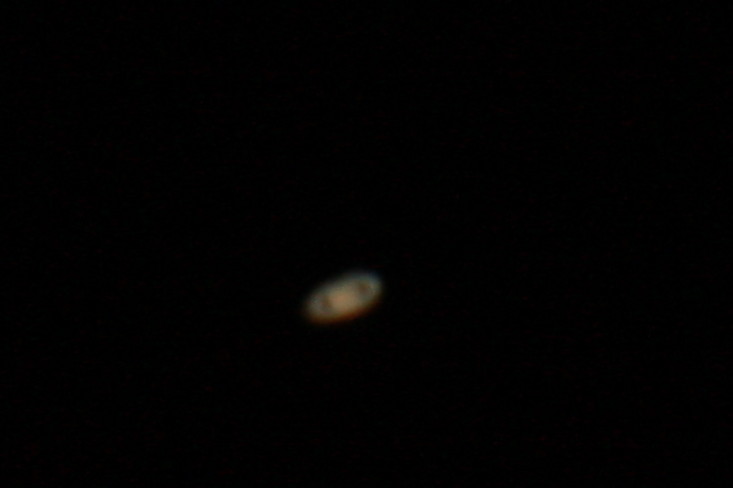
Uncropped, unprocessed image of Saturn.


Saturn, long exposure image to show Moons.

Saturn.
Uncropped image of double star Algorab.


Double Star Algorab in Corvus.

Corvus facing SW.


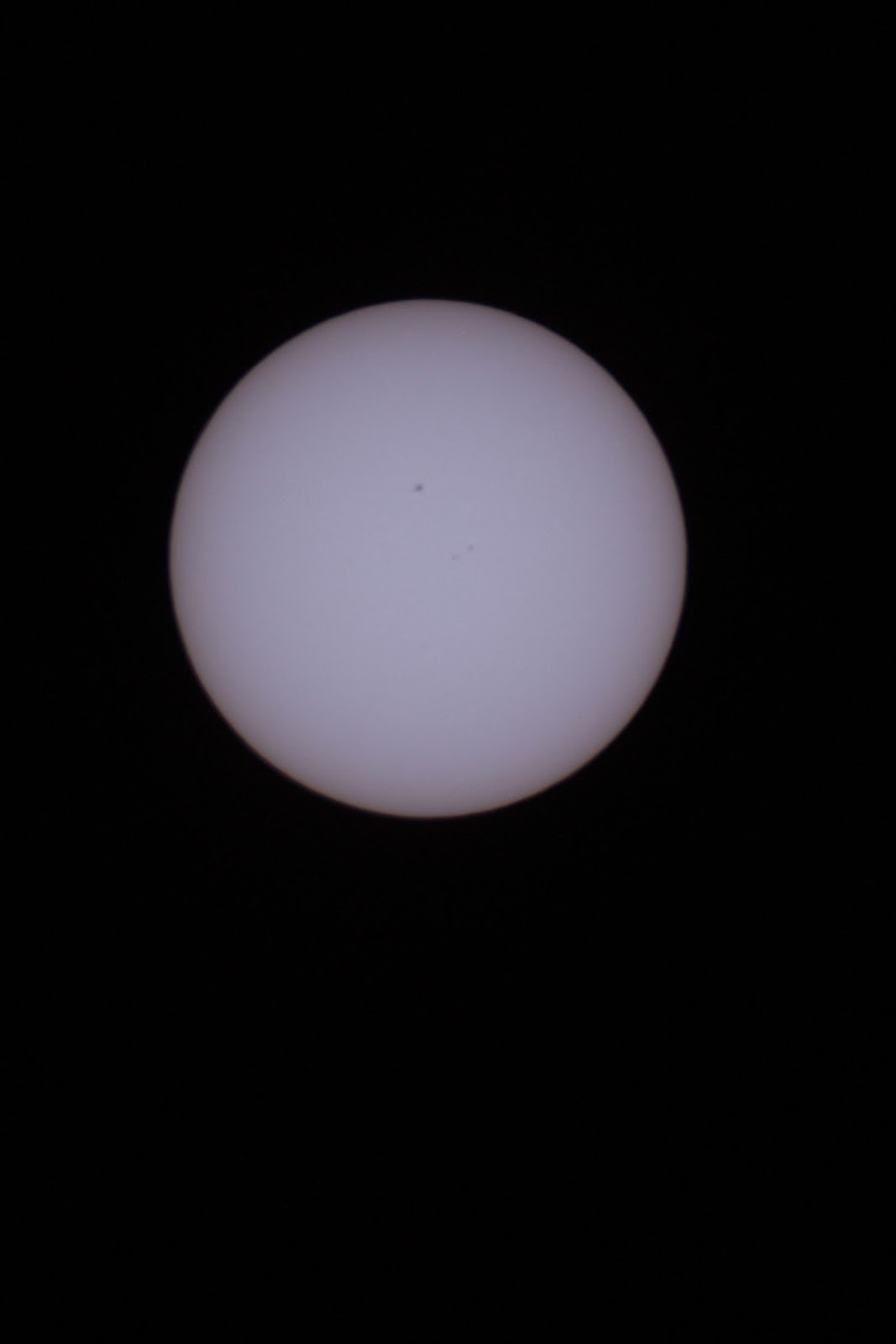
Sun from the morning of May 10 with two sunspot groups.

Followers

Blog Archive