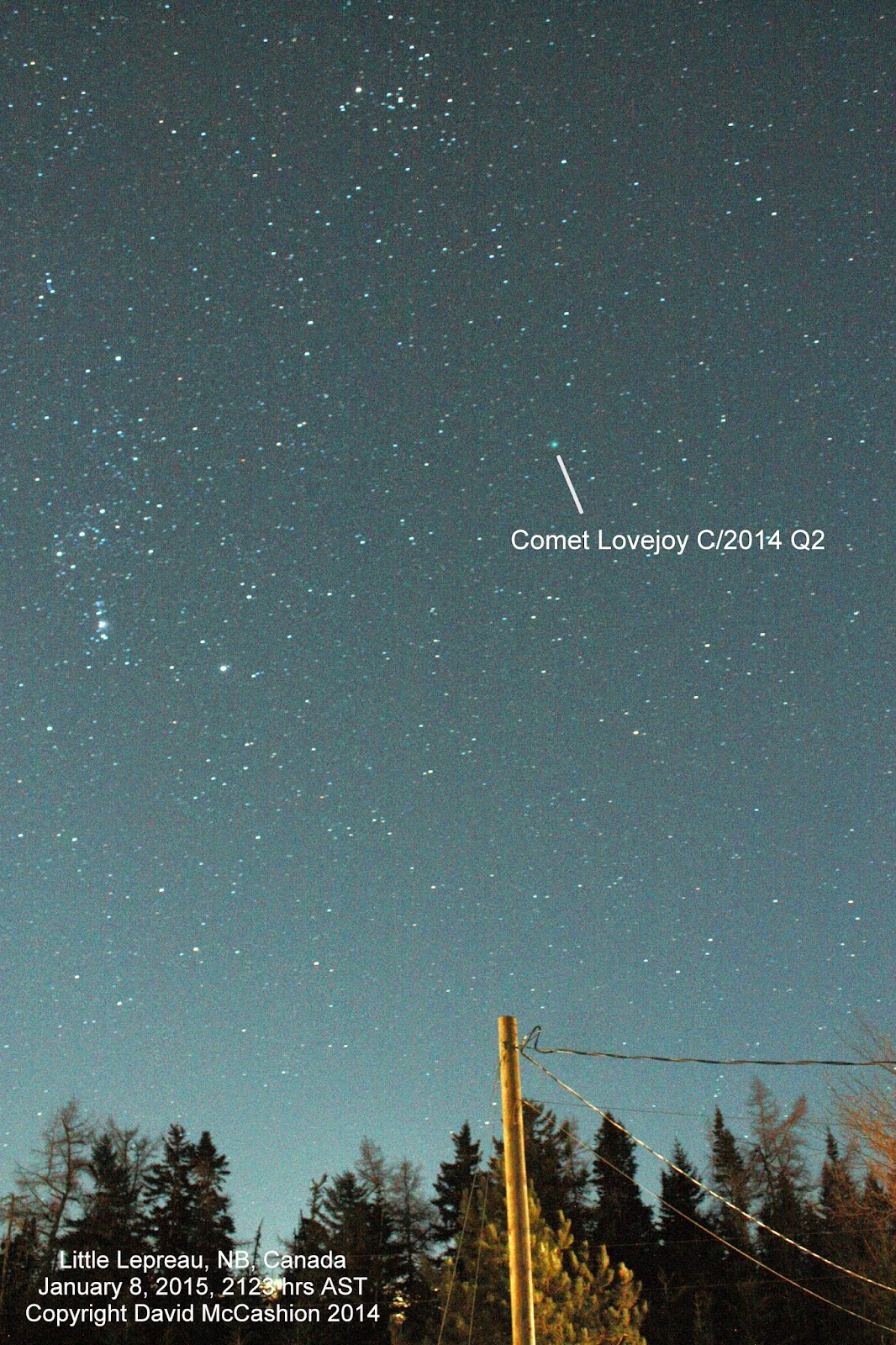
Location: Little Lepreau, NB, Canada-Backyard
Date Time: March 16, 2015 1940-2300hrs
Weather: No wind, clear with slightly hazy skies, -4C @ 1940hrs, -14C @ 2300hrs.
Attendance: Myself.
Equipment: Canadian Telescopes 80ED/APO on Vixen Mount, 8" Meade LX200 telescope with 19mm and 12mm eyepieces, Canon Rebel DSLR with 18-55mm and 75-300mm lenses.
Objective: To view an image Comet Lovejoy which was in Cassiopeia.
Report: Viewed Venus, Jupiter and split Mintaka with 80ED/APO. Venus showed as a very bright gibbous disk. Jupiter showed as a huge disk with bright storm cloud bands and the four Moons separated evenly with two on one side and two on the other. Mintaka split nicely into its double star system, with the smaller star being a brilliant light blue.
With 8" Meade viewed Comet Lovejoy which was in Cassiopeia just to the right of Ruchbah. It showed as a grayish fuzzball.
With Canon DSLR took long exposure images of Comet Lovejoy, Orion's Belt, and M42. In the image of Orion's Belt a Nebula popped out above just above Alnitak. After researching nebula in Orion, it turns out it was The Flame Nebula NGC 2024.
No shooting stars and several satellites were seen.
Wednesday, March 18, 2015
Friday, March 13, 2015
OBSERVING REPORT FOR MARCH 12, 2015
Location: McPherson Beach, NB, Canada
Date Time: March 12, 2015 2100-2145hrs
Weather: No clouds, gusty winds, -11C with a reported winchill of -19C.
Attendance: Myself.
Equipment: Canon Rebel DSLR camera with 18-55mm and 75-300mm lenses, 20x80 binoculars, tripod.
Objective: To locate, view and image Uranus which was reportedly near Mars and easily visible after sun-down. Finding Uranus would be a 'first for me' event.
Report: As soon as I set the binoculars on Mars and scanned just below the Red Planet, the bluish green Uranus stood out instantly, just above the treetops, in the western sky. The first time locating it on my own! It is a very faint planet that resembles just another background star...the distinctive color sets it apart.
Gusty winds made imaging very difficult. Made keeping the camera still for the time exposure images very difficult.
Tried to find Comet Lovejoy in Cassiopeia with naked-eye and averted vision, but it didn't pop out. Was in a much darker area, with no streetlights nearby and my vision did adjust for the dark. This comet is not a naked-eye comet, in my opinion.
Did not use the binoculars to view the comet on this night. With the gusting wind and freezing temperatures I decided to focus on imaging the comet instead.
After comparing images taken earlier in Dec and Jan, it can easily be seen that the comet has dimmed dramatically, but the tail has brightened and enlarged.
One Satellite was seen going from the SE to the NE, almost through the Big Dipper. One shooting star was seen going coming almost straight down, through Cassiopeia, just before I imaged that area.
Date Time: March 12, 2015 2100-2145hrs
Weather: No clouds, gusty winds, -11C with a reported winchill of -19C.
Attendance: Myself.
Equipment: Canon Rebel DSLR camera with 18-55mm and 75-300mm lenses, 20x80 binoculars, tripod.
Objective: To locate, view and image Uranus which was reportedly near Mars and easily visible after sun-down. Finding Uranus would be a 'first for me' event.
Report: As soon as I set the binoculars on Mars and scanned just below the Red Planet, the bluish green Uranus stood out instantly, just above the treetops, in the western sky. The first time locating it on my own! It is a very faint planet that resembles just another background star...the distinctive color sets it apart.
Gusty winds made imaging very difficult. Made keeping the camera still for the time exposure images very difficult.
Tried to find Comet Lovejoy in Cassiopeia with naked-eye and averted vision, but it didn't pop out. Was in a much darker area, with no streetlights nearby and my vision did adjust for the dark. This comet is not a naked-eye comet, in my opinion.
Did not use the binoculars to view the comet on this night. With the gusting wind and freezing temperatures I decided to focus on imaging the comet instead.
After comparing images taken earlier in Dec and Jan, it can easily be seen that the comet has dimmed dramatically, but the tail has brightened and enlarged.
One Satellite was seen going from the SE to the NE, almost through the Big Dipper. One shooting star was seen going coming almost straight down, through Cassiopeia, just before I imaged that area.
Thursday, March 12, 2015
OBSERVING REPORT FOR MARCH 11, 2015
Location: Saint John to Little Lepreau, NB, Canada
Date Time: March 11, 2015 2020-2300hrs
Weather: No wind, no clouds zero degrees C.
Attendance: Carla M, Jessica K, Becky L Ed O in SJ via email and Myself.
Equipment: Canon Rebel DSLR with 75-300mm lens, 20x80 binoculars, and tripod.
Objective: To image and view Venus, Mars and Uranus which were in the Western sky at sundown. To locate and image Comet Lovejoy C/2014 Q2 which was in Cassiopeia as per star chart sent to me via email by Ed O of the Saint John Astronomy Club.
Report: Left the pool at Howard Johnson's in Saint John and watched the western sky on the drive home. Venus and Mars were high up with the extremely bright Venus far above the faint Mars. According to reports, Uranus was close to Mars. Carla asked if we could see Uranus...we looked and could not see it. Later in the evening Ed O reported seening Uranus below Mars.
By the time we got home around 2100 , Venus was just above the treetops with Mars far below...no images were taken.
After a very long, cold, stormy winter, the weather finally improved to where the equipment was safe to take out.
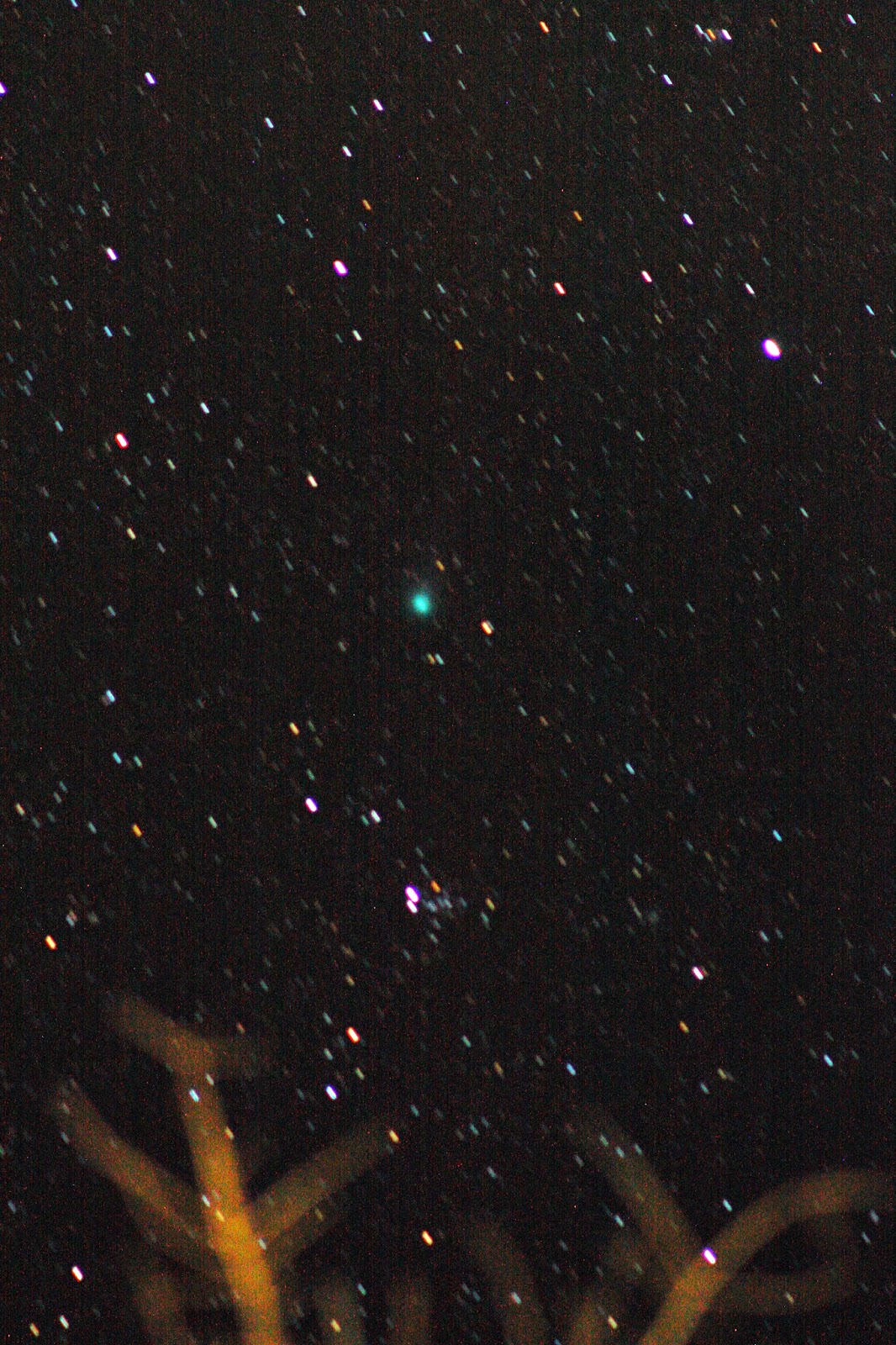
At approximately 2200hrs went out by myself with camera and binos to try to find Lovejoy. Cassiopeia was just above the treetops to the north-west. The first 30 second image showed the fuzzy green ball of Lovejoy right in the middle of the great W of Cassiopeia, exactly where Eds' star chart said it would be!
Took about 6 or 7 long exposure images of the comet, then set the binos up on the tripod to try to spot it. It was not a visible to the naked eye. It must be noted that my eyes never adjusted to the dark, because of a spotlight in the backyard. Once the binos were directed towards the middle of the W just above the treetop, it stood out as a grayish fuzzball. It seemed to have a very thick, very faint tail going straight up covering a nearby star. The comet was huge and kind of faint in the binos, but unmistakenly there and easy to find.
After viewing the comet, a search for the nearby Perseus Double Cluster was done. It was easily located, above and to the west of the big W. Dozens of stars could be seen and impressed my how bright it was, but could not locate it naked eye. The double cluster resembled a double birdshot shotgun blast on target paper. This cluster was huge and bright in the binos...very easy to find, if you know where to look.
No shooting stars or Satelites were seen. Many aircraft were flying through and near Cassiopeia from 2200-2300hrs
Date Time: March 11, 2015 2020-2300hrs
Weather: No wind, no clouds zero degrees C.
Attendance: Carla M, Jessica K, Becky L Ed O in SJ via email and Myself.
Equipment: Canon Rebel DSLR with 75-300mm lens, 20x80 binoculars, and tripod.
Objective: To image and view Venus, Mars and Uranus which were in the Western sky at sundown. To locate and image Comet Lovejoy C/2014 Q2 which was in Cassiopeia as per star chart sent to me via email by Ed O of the Saint John Astronomy Club.
Report: Left the pool at Howard Johnson's in Saint John and watched the western sky on the drive home. Venus and Mars were high up with the extremely bright Venus far above the faint Mars. According to reports, Uranus was close to Mars. Carla asked if we could see Uranus...we looked and could not see it. Later in the evening Ed O reported seening Uranus below Mars.
By the time we got home around 2100 , Venus was just above the treetops with Mars far below...no images were taken.
After a very long, cold, stormy winter, the weather finally improved to where the equipment was safe to take out.
At approximately 2200hrs went out by myself with camera and binos to try to find Lovejoy. Cassiopeia was just above the treetops to the north-west. The first 30 second image showed the fuzzy green ball of Lovejoy right in the middle of the great W of Cassiopeia, exactly where Eds' star chart said it would be!
Took about 6 or 7 long exposure images of the comet, then set the binos up on the tripod to try to spot it. It was not a visible to the naked eye. It must be noted that my eyes never adjusted to the dark, because of a spotlight in the backyard. Once the binos were directed towards the middle of the W just above the treetop, it stood out as a grayish fuzzball. It seemed to have a very thick, very faint tail going straight up covering a nearby star. The comet was huge and kind of faint in the binos, but unmistakenly there and easy to find.
After viewing the comet, a search for the nearby Perseus Double Cluster was done. It was easily located, above and to the west of the big W. Dozens of stars could be seen and impressed my how bright it was, but could not locate it naked eye. The double cluster resembled a double birdshot shotgun blast on target paper. This cluster was huge and bright in the binos...very easy to find, if you know where to look.
No shooting stars or Satelites were seen. Many aircraft were flying through and near Cassiopeia from 2200-2300hrs
![]() |
| The red line is an airplane trail. |
Saturday, January 10, 2015
Venus/Mercury 0.7 Degrees Apart
Location: Samuel De Champlain School, Saint John, NB
Date Time: January 8, 2015 around 1800hrs AST
Weather: Clear, light wind, -23C.
Equipment: Canon Rebel Xsi with 75-300mm lens mounted on tripod.
Attendance: Myself.
Objective: To view and image Venus/ Mercury Conjunction.
Report: While on my travels throughout SJ on this particular day, was prepared to pull over anywhere safe to image this conjunction. Was informed at last Saint John Astronomy Club meeting about the conjunction, and was pleasantly surprised when the forecast cooperated.
Date Time: January 8, 2015 around 1800hrs AST
Weather: Clear, light wind, -23C.
Equipment: Canon Rebel Xsi with 75-300mm lens mounted on tripod.
Attendance: Myself.
Objective: To view and image Venus/ Mercury Conjunction.
Report: While on my travels throughout SJ on this particular day, was prepared to pull over anywhere safe to image this conjunction. Was informed at last Saint John Astronomy Club meeting about the conjunction, and was pleasantly surprised when the forecast cooperated.
Comet Lovejoy C/2014 Q2 Over New Brunswick
Location: Little Lepreau and near Chance Harbour, NB, Canada
Date Time: December 30, 2014 to January 17, 2015 usually around 2100hrs to 2330hrs.
Weather: Clear, no wind to mild breezes, -18C to -25C.
Attendance: Carla, Leah, Jessica, Madison, McKenzie, Brandon, Edward O, and Myself.
Equipment: Canon Rebel Xsi with 18-55mm and 75-300mm lenses mounted on Tripod. Canadian Telescopes 80ED/APO with 32mm, 19mm and 12mm eyepieces and Ed's 8" Dobsonion.
Objective: To view and image Comet Lovejoy C/2014 Q2 which was heading from through Lepus The Hare to Taurus The Bull to just southwest of M45.
Report: This has been an excellent target to view over these nights. Its very easy to locate with binoculars, because its relatively low in the sky and shows up like a huge slightly dark green fuzzball in the eyepiece. Long exposure images clearly show the distinctive green hew, which makes it easy to distinguish from the background stars.
Jan 9/15 was the first time I have been able to see it naked eye. It's very faint, but with averted vision, the size of it stands out. Its huge! Ed O and I observed it naked eye Jan 17. On this moonless night it stood out plainly.
Leah remarked that it looked like a faint star with a 'dark shadow' around it, while four year old McKenzie said it looked like a 'fuzzball' to her. No else, but me picked up the color. Have to wonder if its because I seen it in photographs before, and knew to look for green.
In the images below, look for the date. It can be easily seen how the Comet has moved across the sky, when compared to background Constellations, Orion, Lepus and Taurus.
No Shooting stars or satellites were observed during observation period...which is surprising in itself, as the sky was closely observed, trying to locate the comet, for many hours over these dates.
Tuesday, December 30, 2014
CHRISTMAS NIGHT OBSERVING 2014
Location: Little Lepreau, NB, Canada
Date: December 25, 2014
Weather: Stormed all day, rain, high winds temps up to 15 C. By 1700hrs rain stopped, then shortly after the clouds started to break up. A few minutes later, clouds cleared off completely! From 1730-2000hrs, temps went from 8C to 2C, but high winds remained throughout. At 2015hrs clouds returned.
Equipment: Big main telescope, DSLR camera with 18-55mm lens and cellphone camera with Ioptron adapter.
Attendance: Madison, McKenzie, Andrew and Myself.
Objective: To view and image the Crescent Moon, and to explore the Constellation Agrila, the Charioteer along with its Kids and Messier Objects, M36, M37 and M38.
Report: At 1715 hrs, just after Christmas Supper, McKenzie looked out the window and exclaimed, "Look, the Moon!". This came as a surprise, because the weather forecast was not calling for clear skies...At this point it was decided to set the scope up and do some Christmas Evening observing.
At 1730, a thin Crescent Moon was part way up in the sky in the Constellation Aquarius, with Mars below it in Capricornus.
Set scope up on the the front deck and aligned it on Aldebaran, which was in the east and half way up in the sky at Sundown. Located the Moon, then viewed it with 32mm and19mm eyepieces, then imaged with cellphone camera attached to eyepiece slot of telescope. Used DSLR camera attached piggyback to telescope with 18-55mm lens to image the Moon-Mars-Sadalsuud. Wind and the shaky deck were major factors when trying to image the Moon.
Sadalsuud, which was next to the Moon, is Arabic for 'Luckiest of the Lucky'. This is a star in Aquarius. There are many stars in the sky that are named in Arabic.
Set the Cellphone, in its adapter, into the eyepiece, then turned on camera function. This showed the Moon on the view screen and allowed for the user to zoom in or out. Everyone in attendance viewed the Moon this way. Many videos were taken.
Andrew and I located Constellations Ursa Major (North, under Polaris), Cygnus the swan (North west), Orion (Low in South east), Agrila The Charioteer (East) above Gemini, and Cassiopeia high over head to the East.
Viewed M42 and M43 in telescope with 19mm eyepiece. Some color could be seen in the nebula, and the trapezium stars were resolved, even though it was so low in the sky at the time, behind transmission lines.
Slewed scope to the North east, towards Agrila and took time 1 minute time elapse images of this Constellation, in order to locate M36, M37, and M38. At this point(2000hrs), it was time to go inside to warm up, have some hot chocolate and view images. After 15 minutes, came back out and the sky had clouded over and winds increased significantly. Equipment had to be brought inside quickly, as rain looked imminent.
One satellite was observed at around 1900hrs moving south east, just over the Moon. No shooting stars were observed.
Date: December 25, 2014
Weather: Stormed all day, rain, high winds temps up to 15 C. By 1700hrs rain stopped, then shortly after the clouds started to break up. A few minutes later, clouds cleared off completely! From 1730-2000hrs, temps went from 8C to 2C, but high winds remained throughout. At 2015hrs clouds returned.
Equipment: Big main telescope, DSLR camera with 18-55mm lens and cellphone camera with Ioptron adapter.
Attendance: Madison, McKenzie, Andrew and Myself.
Objective: To view and image the Crescent Moon, and to explore the Constellation Agrila, the Charioteer along with its Kids and Messier Objects, M36, M37 and M38.
Report: At 1715 hrs, just after Christmas Supper, McKenzie looked out the window and exclaimed, "Look, the Moon!". This came as a surprise, because the weather forecast was not calling for clear skies...At this point it was decided to set the scope up and do some Christmas Evening observing.
At 1730, a thin Crescent Moon was part way up in the sky in the Constellation Aquarius, with Mars below it in Capricornus.
Set scope up on the the front deck and aligned it on Aldebaran, which was in the east and half way up in the sky at Sundown. Located the Moon, then viewed it with 32mm and19mm eyepieces, then imaged with cellphone camera attached to eyepiece slot of telescope. Used DSLR camera attached piggyback to telescope with 18-55mm lens to image the Moon-Mars-Sadalsuud. Wind and the shaky deck were major factors when trying to image the Moon.
Sadalsuud, which was next to the Moon, is Arabic for 'Luckiest of the Lucky'. This is a star in Aquarius. There are many stars in the sky that are named in Arabic.
Set the Cellphone, in its adapter, into the eyepiece, then turned on camera function. This showed the Moon on the view screen and allowed for the user to zoom in or out. Everyone in attendance viewed the Moon this way. Many videos were taken.
Andrew and I located Constellations Ursa Major (North, under Polaris), Cygnus the swan (North west), Orion (Low in South east), Agrila The Charioteer (East) above Gemini, and Cassiopeia high over head to the East.
Viewed M42 and M43 in telescope with 19mm eyepiece. Some color could be seen in the nebula, and the trapezium stars were resolved, even though it was so low in the sky at the time, behind transmission lines.
Slewed scope to the North east, towards Agrila and took time 1 minute time elapse images of this Constellation, in order to locate M36, M37, and M38. At this point(2000hrs), it was time to go inside to warm up, have some hot chocolate and view images. After 15 minutes, came back out and the sky had clouded over and winds increased significantly. Equipment had to be brought inside quickly, as rain looked imminent.
One satellite was observed at around 1900hrs moving south east, just over the Moon. No shooting stars were observed.
![]() |
| Looking South-West |
![]() |
| Looking East |
![]() |
| Looking South-East |
Sunday, November 23, 2014
OBSERVING REPORT FOR NOVEMBER 19, 2014
Location: Little Lepreau, New Brunswick, Canada
Date Time: November 19, 2014 1630-2120hrs
Weather: Clear, windy at 1600hrs, wind slowly died down to nothing by 1900hrs. -2 degrees Celsius, felt like -8 degrees Celsius according to weather station.. Upper atmosphere disturbed.
Attendance: Maddison and McKenzie, Leah, Jessica, Rebecca, Carla and Myself.
Equipment: Canon xsi dslr with 75-300mm and 18-55mm lenses piggybacked to 8" Meade LX 200 telescope with goto and tracking capabilities. Eyepieces 32mm, 12.5mm and 4mm. Ioptron cellphone adapter and nexus 4 cellphone camera and video.
Objective: To attempt to image anything with new cellphone adapter.
Report: Main highlight was a Bolide (fireball) that streaked straight down, due south of my position on the front porch at 2020hrs. It was very bright and went very low behind the trees when it flashed and completely lit up the entire dark night for a second. Could actually hear a quiet hissing, searing sound and could see a smoke trail for an instant, from the flash!
1830 hrs cellphone video of Mars was taking using new cellphone adapter. It worked fine, but because Mars is so far away in its orbit right now, no detail could be found when the video was processed in stacked. Earth will get closer to Mars next summer and we might get better detail then.
Showed Mars with 12.5mm eyepiece to Maddison and McKenzie, Leah, Jessica, Rebecca. They all seemed impressed with everyone wondering if the planet was 'on fire'. Carla viewed the cellphone video and seemed impressed.
Used piggybacked dslr camera to capture images of a closeup of M45, Cassiopeia, Perseus Double Cluster, M31, Cygnus, The Summer Triangle, Delphinus, Taurus, and Orion.
Date Time: November 19, 2014 1630-2120hrs
Weather: Clear, windy at 1600hrs, wind slowly died down to nothing by 1900hrs. -2 degrees Celsius, felt like -8 degrees Celsius according to weather station.. Upper atmosphere disturbed.
Attendance: Maddison and McKenzie, Leah, Jessica, Rebecca, Carla and Myself.
Equipment: Canon xsi dslr with 75-300mm and 18-55mm lenses piggybacked to 8" Meade LX 200 telescope with goto and tracking capabilities. Eyepieces 32mm, 12.5mm and 4mm. Ioptron cellphone adapter and nexus 4 cellphone camera and video.
Objective: To attempt to image anything with new cellphone adapter.
Report: Main highlight was a Bolide (fireball) that streaked straight down, due south of my position on the front porch at 2020hrs. It was very bright and went very low behind the trees when it flashed and completely lit up the entire dark night for a second. Could actually hear a quiet hissing, searing sound and could see a smoke trail for an instant, from the flash!
1830 hrs cellphone video of Mars was taking using new cellphone adapter. It worked fine, but because Mars is so far away in its orbit right now, no detail could be found when the video was processed in stacked. Earth will get closer to Mars next summer and we might get better detail then.
Showed Mars with 12.5mm eyepiece to Maddison and McKenzie, Leah, Jessica, Rebecca. They all seemed impressed with everyone wondering if the planet was 'on fire'. Carla viewed the cellphone video and seemed impressed.
Used piggybacked dslr camera to capture images of a closeup of M45, Cassiopeia, Perseus Double Cluster, M31, Cygnus, The Summer Triangle, Delphinus, Taurus, and Orion.
![]() |
| This is 380 images stacked of Mars. |
Subscribe to:
Posts (Atom)