Twitter

Saturday, May 21, 2016

MARS CLOSE

Location:  Little Lepreau, NB, Canada

Date Time:  May 20, 2016 2055-0300hrs ADT

Weather:  @ 2055hrs-Breezy, mostly clear, 12C.  Not dark till 2130hrs.
@0300hrs- see-through fog, hazy, otherwise clear, 4C no wind.
Didn't get dark until after 2130hrs.

Equipment:  Big scope, with 4mm, 9mm, 19mm, 32mm, 1.5x Barlow, yellow filter, and a .6 focal reducer.  Nexus 4 cellphone camera and Canon Rebel Xsi camera with telescope attachment.

Attendance:  MacKenzie C, Maddison C, Leah C, Edward O and David M.

Objective:  To view and image Mars, Saturn, Jupiter and the Moon.

Highlights:

  • Moon was one day before full....was very bright, low in the SE at beginning of observing.
  • Maddison and MacKenzie both were very interested in the Moon.  Maddy noted 'circles' and Kenzie noted 'mountains.  They viewed it through the big scope with the 2", 32mm eyepiece.
  • Leah viewed the nearly Full Moon, Jupiter and Saturn.  Was her first time viewing Saturn.
  • Ed and I both observed Mars and noted how big and bright it was compared to even a few months ago.  We both seen detail across the disk in the form of a smiley face mouth.  We both noticed a faint lightening on one edge of the Red planet that could have been a polar cap.
  • Ed, Leah and I observed Jupiter and all noted how big the gas giant appeared in eyepiece we discussed one of its visible moons, Europa...how it could possibly harbour life.  Ed noticed three cloud stripes across the disk of Jupiter, where I noted two.
  • Ed, Leah and I observed Saturn with Leah noting that this was her first view of the ringed planet.  Definite separation between planet and rings, but no Cassini division observed.
  • No shooting stars or satellites were seen.
Images:


Jupiter


Note smiley face lips.  


Tuesday, May 10, 2016

OBSERVING REPORT FOR MAY 9 AND 10 2016

Location:  Front Porch, Little Lepreau, NB, Canada

Date Time:  May 9/10, 2016  2330-0230hrs

Weather:  Breezy, 6C windchill 3C, partly cloudy to cloudy at times.  Mostly clear after 0100hrs.

Equipment:  Big Scope, little scope, 19mm eyepiece and 32mm eyepiece, DSLR camera.

Attendance:  Myself.

Objective:  To view and image Mars which is close to the Earth at this time, due to Mars and Earths orbital positions.

Highlights:

  • Jupiter was very bright with one of its cloud bands standing out much brighter than the second one.  Three moons were on one side of the planet with the other a long way away on the other side.  One Moon appeared to pass just under another Moon during observing time.
  • Mars was a large bright red disk in the eyepiece.  Huge compared to last year, when it was on the other side of the Sun.  No detail could be made out across the disk.
  • M13 was bright and big and easy to find in Hercules half way up the sky due East at around 2330hrs.  Many, many stars coud be seen across the face and on the outside of the massive globular cluster.
  • Algorab the double star in Corvus was easily split with big scope.  In eyepiece, the main star shown a very bright blue, slightly greenish around the edge, whereas the other lesser star was a faint light reddish.  These stars are very close together in eyepiece.
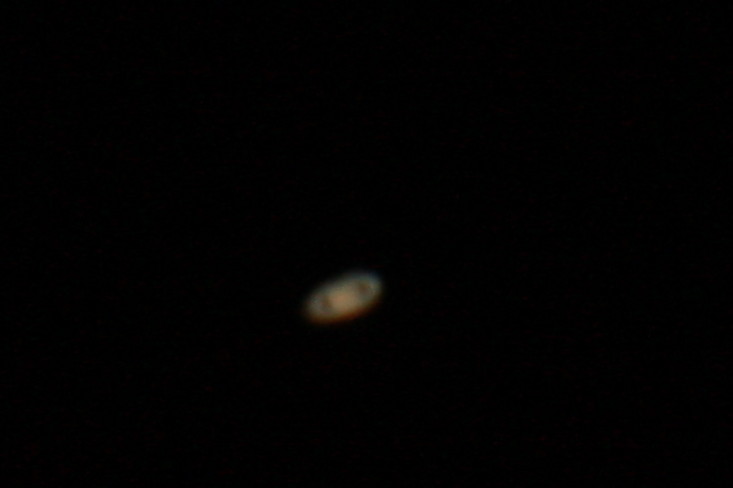
  • Saturn and a number of its moons stood out nicely in eyepiece. The Moons appear to rotate around the ringed planet in an oval shape, which is much different than how Jupiters Moons appear to orbit it. A Separation in between the Saturns disk and its rings was easily seen.  The rings inclination is quite steep at this time.
  • Searched below Corvus for M68, but did not find it.  Clouds cover this area of the sky shortly after my search began.  Planned a M104, Sombrero Galaxy search, but the clouds remained for a long time in that area.  When they finally passed, that area of the sky was too low in the SW for good observing.  A bright shooting star split Corvus in half just before the clouds moved in.
  • Three shooting stars were seen, maybe more though not confirmed as they were out of the corner of my eye.  No satellites were seen.
Images:

Facing SW at 2330hrs.

Jupiter and 4 of its Moons.

Jupiter.

Facing almost due south at 0144hrs.


Mars

Mars
Uncropped, unprocessed image of Saturn.


Saturn, long exposure image to show Moons.

Saturn.
Uncropped image of double star Algorab.


Double Star Algorab in Corvus.

Corvus facing SW.


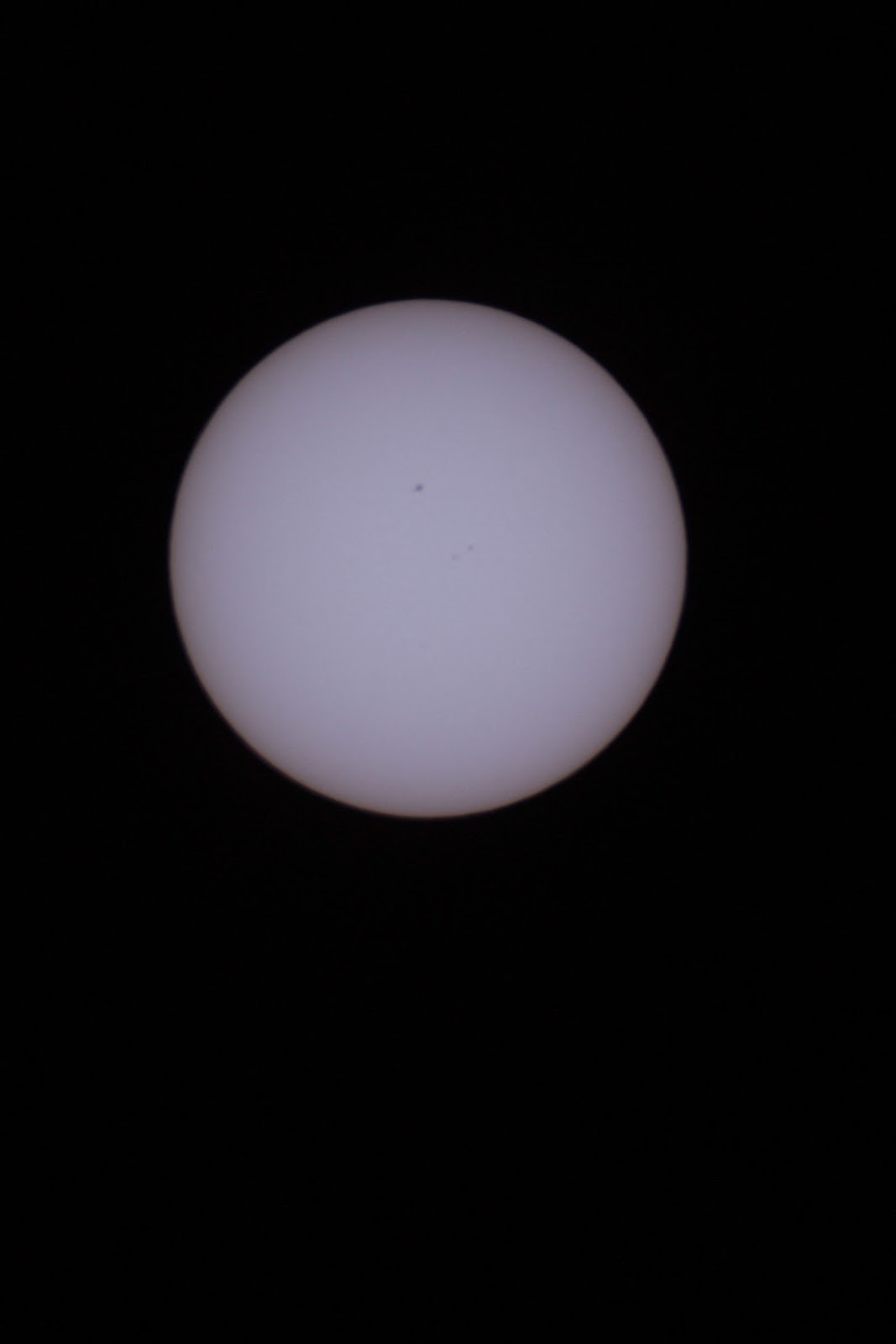
Sun from the morning of May 10 with two sunspot groups.

Sunday, April 17, 2016

OBSERVING REPORT FOR APRIL 15, 2016

Location:  Lower West Side Saint John, NB, Canada

Date Time:  April 15, 2016 2120-2200hrs AST

Weather:  Very windy, Clear, 1C with windchill of -6C.  A long stretch of relatively nice weather has allowed for succesive night observing, which has been a rarity since last fall.

Attendence:  Ed O and Myself

Equipment:  Canadian Telescopes 80mm ED/APO on a Vixen Alt/AZ mount and Canon Rebel Xsi with 18-55mm lens on a tripod.

Objective:  To view and image Mercury, the Moon and Jupiter.

Highlights:

  • Ed and I easily found Mercury over the Paper Mill, low in the West, showing up as a fairly bright star, just after evening twilight.  Ed commented on how high up it was.
  • A satellite was observed heading North through the Big Dipper.  Ursa Major was upside down and over polaris, high in the NNE.
  • Telescope was used to view the Moon.  
  • Jupiter was halfway up in the sky, in the SSE.  It was very close to a fairly bright star in Leo.  Ed and I both noted how close it was to the star, at first glance, through the telescope the star looked like one of Jupiters Moons.
  •  In the telescope, with 32mm eyepiece, three of its Moons showed up.  With higher magnification of the 4mm eyepiece the fourth Moon was very close to the gas giant.  Looked for a shadow on Jupiters' disk, but didnt see one.
Images:

Looking West at 2120hrs.


Note one of Jupiters Moons are very close to it, on the right side in the image

Cropped, close-up image of Jupiter


Thursday, April 14, 2016

OBSERVING REPORT FOR APRIL 13, 2016

Location:  Lower West side Saint John, NB

Date Time:  April 13, 2016 2100-2110hrs

Weather: Clear, breezy, 4C with windchill of 0C

Attendance:  Myself.

Equipment:  Canon Rebel Xsi with 75-300mm lens on tripod.

Objective:  To view and image Mercury which was suppose to be low in the West just after sundown.

Highlights:

  • Mercury was spotted easily, just above the paper mill, looking west, in the dusk twilight just after 2100hrs.  It showed up as an 'un-twinkling star', above the smoke from the factory.
  • After viewing and imaging Mercury, noticed a bright 'star' moving across the Northern sky.  Took a 5 second image of it as it faded in the NE.  Confirmed on Heavens-above.com that its indeed the International Space Station.  According to the website and partially confirmed by my observation, the orbiting space station was suppose to make a long pass over our location from 2100-2106hrs.  It was just going out of sight as the camera started taking the image.
  • Orion is now sitting low in the SW just after sundown.  It's brightest stars were just barely visible.
  • A first Quarter Moon was in Gemini.
  • Jupiter was shinning very bright in the SSE, fairly high up.
Images:
ISO 400, Shutter speed 1 second, F/5, Focal Length 170mm.

ISO 400, Shutter speed 5 seconds, F/4.5, Focal Length 75mm.


Wednesday, April 6, 2016

COMET 252P LINEAR AND MERCURY

Location:  Morning - West Saint John, NB, Canada

Evening - Prince of Wales, NB, Canada

Date Time:  April 5, 2016 0500-0615hrs and 2045-2050hrs

Weather:  Morning - Mostly clear, though many fast moving see-through clouds in Comets' direction proved challenging, -8C windchill -16C, high winds bitter cold.

Evening - Clear, light breeze to no wind, -5C windchill -9C.

Attendance:  Morning - Ed O and Myself.

Evening - Myself.

Equipment:  Canon Rebel Xsi with 75-300mm lens on a tripod.  Eds' 15x70 Binoculars.

Objective:  To view and image Comet 252P Linear which was reported to be rising in the SSE morning sky before dawn.

Highlights:
Morning

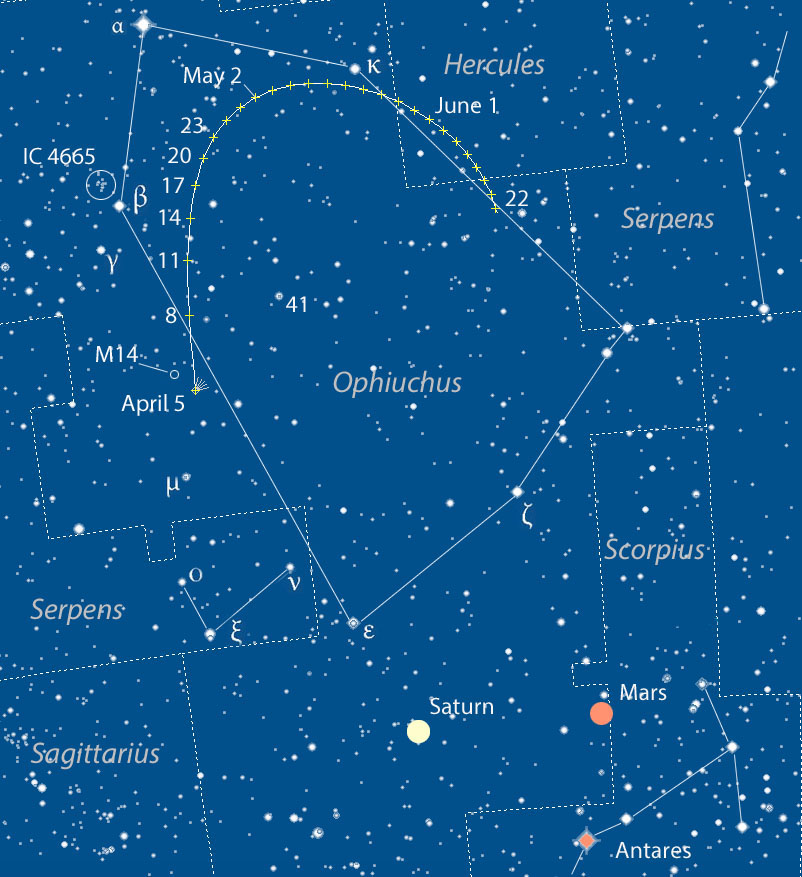
  • Comet Linear was reported to be in Ophiuchus, just above and to the left of the pairing of Saturn and Mars.
  • Ed and I both noted how bright Mars appeared.  Much brighter than Saturn.
  • We located the Comet easily with Ed binoculars, with both of us noting how big it appeared in field of view.  Ed thought he could see green in the comet where I just thought it looked like a very dark, sort of grayish hazy patch, next to a bright star.
  • During observing time Comet was at about 45 degrees elevation.   We both noted how high it was becoming.  The Comet is moving higher in our morning sky each day.
  • Neither of us could see Comet with naked-eye.  Needed binos to see it.
  • Could not see it through camera lens, so had to guess where to aim camera.  Of many images taken, Comet only showed up in two images.  These images only appeared after downloading on computer and then processing.  Comet then popped out in one image, next to a passing satellite.
  • This Comet has proven to be challenging to view and image for several reasons.  Our weather has been mostly cloudy, with heavy winds since it first came into view around March 31.  Also the Moon phase up until April 2 has been a major factor.  On April 1, it was clear, but the third quarter Moon was very bright and almost right on top of the Comet.  April 5 morning, though extremely cold and windy with some fast moving clouds, was the first decent chance to view it.
Evening:

  • On Hwy 1 west of Saint John, noticed Mercury pop into view low in the Western twilight sky.  Stopped along the side of the road in Prince of Wales and imaged it.  Appeared as a lone, un-twinkling star.
Note:  Comet 252P Linear was accompanied by another Comet, Comet 2016 BA14.  According to Space.com, 252P Linear came within 14 Lunar distances of Earth or 5.6 Million Kms, making it the 5th closest Comet to Earth.

Comet BA14 came within 9 Lunar Distance or 3.4 Million Kms.  This would make it the second closest Comet to Earth after Comet D/1770 L1 Lexell which buzzed Earth in the year 1770 at a distance of 6 Lunar Distances or 2.2 Million Kms.


Images:
Finder Chart from www.skyandtelescope.com


Region Comet was in during observing and imaging on April 5, 2016.


Path of Comet 252P Linear at time it was imaged, April 5, 2016 @ 0515hrs AST.

Path of Comet 252P Linear during close approach to Earth on March 19, 2016.  Image shows how close came to Earth.


Satellite passes above Comet during imaging.


Monday, March 7, 2016

BAHAMAS OBSERVING MARCH 2016

Location:  Off the coast of Nassau, Bahamas, aboard the Norwegian Breakaway.  Set up on our Port side Balcony and on the upper deck facing the starboard side.

Date Time:  March 2 and 3, 2016 1930-2000hrs and 0403-0535hrs EST

Weather:  Mostly clear in the evening to mostly cloudy in the morning.  No wind in the evening to strong gusting winds in the morning, a warm 28C humid.

Equipment:  Canon Rebel Xsi with 18-55 and 75-300 mm lenses, 20x80 binoculars and a tripod.

Attendance:  Myself.

Objective:  To locate, view and image Constellation Crux and Alpha Centauri which was due to be just above the southern horizon at 4am EST from Nassau, BH according to the star chart at heavens-above.com

Highlights:

  • Images turned out poor in the morning due to high gusting winds and moving ship.
  • Due to clouds across most of the sky, the Southern Cross nor Alpha Centauri could not be located. Took many images of southern sky, off starboard side of ship, to see if camera could capture stars through the clouds.  Some stars could be seen, but not enough to confirm a constellation.
  • Observed a Waning Crescent Moon, halfway up in the eastern sky in the morning.
  • Jupiter was halfway up in the western sky in the morning.
  • No shooting stars were seen, one satellite was seen in the evening.

Images:

Big Dipper above a passing ship, off the Port side March 2, 2016 0728hrs EST.


Moon upper left, over the bow of ship.  Nassau, BH in distance on the horizon.  Some stars through clouds off starboard side from the top deck of the Norwegian Breakaway.  March 3, 2016 0416hrs EST.


Jupiter next to a bright star in Leo.  March 3, 2016 0506hrs EST.

Jupiter, almost directly aft March 3, 2016 0532hrs EST.

March 3, 2016 0458hrs EST.


Starboard side looking for stars March 3, 2016 0528hrs EST.

Starboard side looking for stars March 3, 2016 0529hrs EST.

Starboard side looking for stars March 3, 2016 0530hrs EST.


Wednesday, February 24, 2016

MOON JUPITER CONJUNCTION

Location:  Front yard, Little Lepreau, NB, Canada.

Date Time:  February 23, 2016 2330-2345hrs

Weather:  Lots of hazy, see through clouds leading to a forecasted snow/rain for next day.  No wind -12C.

Attendance:  Myself

Equipment:  Canon Rebel Xsi with 75-300mm and 18-55mm lenses, tripod.

Objective:  To view and image Moon/Jupiter conjunction, which I viewed earlier in the evening.

Highlights:

  • Moon was 98% illuminated on this night, one day past full.
  • With arm out-stretched, Jupiter was less than one finger width away from the Moon.  This would make it approximately 2 degrees separation between the two celestial bodies.
  • Images taken with both lenses.  Clouds made images extremely bright so that only a low ISO and a very quick shutter speed could be used.
  • Orion was lowering in the western sky.
  • No Satellites or shooting stars were seen.
Images:
Image shows hazy see-through clouds.


ISO 400, 2.5 seconds, F/4.5 and focal length of 25mm.

ISO 100, 1/160 second, F/5.6 and focal length of 300mm.


Followers

Blog Archive