Twitter

Sunday, October 12, 2025

Comet C/2025 A6 Lemmon (Oct 11, 18, & 25)

Location Date Time Weather Equipment:  

Near Fredericton, NB, Canada - October 11, 2025 1930-2030 - Cool, no wind, hazy, 12C, and 94% humidity.   Canadian Telescopes 80 ed/apo with Canon Rebel attached at prime focus.  15x70 binos, images processed with PhotoShop

Prince of Wales, NB, Canada - October 18, 2025 1900-2030 - Air got cooler, ground fog started to form after 2000hrs, no wind, clear, 10C.  Binoculars, Canon Rebel with 18-55mm and 75-300mm lenses. Images processed with photoshop.

Saints Rest Beach, NB, Canada - October 25, 2025 1900-2010 - Cloud and haze moved in around 1930, affecting overall viewing conditions, cool, 9C. Clouds along horizon covered moon many times.  Haze dimmed brighter stars, and made the naked eye comet pop in and out of view. Some breeze to no breeze.

Objective:  To observe two comets, Comet Lemmon in the north-western sky and Comet C/2025 R2 Swan in the south-western sky just after sundown.  Sometime during the week of Oct 11 to Oct 18, a few reports were made that Comet Lemmon is visible naked eye, barely.

Report For Oct 11:  

  • I was able to capture and view Comet Lemmon in binos as it was going down behind trees, also as it was starting to get dark enough to observe it. It was bright enough to clearly see in camera viewscreen, and was easy to find in binos.  Huge, greenish, with a bright, whitish central region.  A hint of a big wedge like tail was just barely visible.  Not visible to naked eye, in my experience.


  • No moon in the sky made for very dark skies, but hazy, high humidity.
  • Searched for Comet Swan, but it had gone down behind trees by the time I was able to search for it.
  • Arcturus was behind trees by the time it started getting dark.
Arcturus 


Report for Oct 18:

  • Ed and I arrived at observing area around 7pm and the sun was down but there was still lots of light.  Arcturus popped out shortly afterwards, but it took a long 30 mins for the twilight to diminish enough for comet Lemmon to appear.
  • We both had nice views of Comet Lemmon through binos.  Noting the big, bright nucleus with bright whitish central region and greenish outer layer.  A large, thick tail sweeping to the right, aprox a degree long.  Around 8pm we realized we could see the Comet naked eye!  We estimate the comet to be 5th magnitude.  What a beautiful sight!


  • We searched the southern sky under Aquila and above Sagittarius for Comet C/2025 R2 Swan to no avail.  Lots of deep sky objects, in Sagittarius, including seven globular clusters, which closely resemble comets in binos.  I confirmed one such cluster with an image.  We thought it was a comet while scanning for comet Swan.  We were not able to confirm a sighting of this comet, even after a thorough scanning by both of us of that region with binos.  This comet was reported to be mag 6.4.
Report for October 25 from Saints Rest Beach
  • Shortly after dark, the comet became visible in binoculars. It has a bright central region, and is huge. Clearly stands out as a comet. Spectacular with tail that spanned 40% of binos field of view, Ed thought and I agree.  It's a long tail that sweeps up and to the left.  Tail is visible naked eye and in images there's some kind of disturbance going on with it.
Comet C/2025 A6 Lemmon


  • In the south, south, western sky, there was a beautifl thin crescent moon that periodically was covered by a thin band of dark clouds.  The southern sky had Sagittarius hanging just over the Bay of Fundy.  Comet c/2025 R2 Swan was in this region of sky but didnt show up in binos or in images of this area of sky.  Many other observers from the Saint John Astronomy Club were there, making it a very enjoyable experience.
Sagittarius sitting low in the sky as a thin cresent moon tries to peek out from behind clouds.

Setting Crescent Moon next to a transmission tower.


Monday, August 25, 2025

Observing Report August 22, 2025

Location:  Mactaquac Provincial Park, NB, Canada

Date Time:  2200-0030hrs August 22, 2025

Weather:  Humid, hazy, dew, some moths, no wind to some breeze, a cool 15C and 80% humidity.

Equipment:  Canadian telescopes 80 ed/apo with canon rebel camera attached at prime focus.  Images processed with PhotoShop.

Attendance:  Other campers and myself.  About five came to view through telescope.

Objective:  To observe some of the brighter deep sky objects that are visible from this location and to share viewing with other campers.

Report:

  • New Moon was at approximately 0300hrs on this night.  Very dark skies but a haziness caused M31 to be somewhat difficult to find naked eye.
  • Showed my camping neighbors around the sky.  Showed M31, M13 and Albireo through big telescope.  Explained about how to use Ursa Major as a guide to find Arcturus and Polaris.  Also, we marveled at the Milky Way which stretched across the entire sky, straight overhead, from the south to the North East into Cassiopeia.
  • Viewed and imaged M31 The Andromeda Galaxy.  M110 also popped out in the image, which was unexpected. Dust lanes can also be seen.


  • During the evening I decided to image each one of the main square asterism stars in the great square of Pegasus.  Perhaps surprisingly Alpheratz, the brightest star of the square isn't a star of the constellation Pegasus, but the brightest star of the constellation Andromeda.


Alpheratz

Algenib

Markab

Scheat

  • While looking at Cassiopeia I thought I would try to capture M103. It is an open star cluster which is near Ruchbah, one of the 'W' asterism stars of Cassiopeia.  The cluster does not appear to show in this image, even after processing to bring out more detail.
Ruchbah

  • Around midnight, a bright star rose from behind a big tree in the East.  It was Saturn!  The almost edge on view of the rings was surprising to me.  Spectacular in the big telescope field of view and at least two moons were clearly visible around the gas giant, with maybe more. I find it difficult to tell some of Saturn's moons apart from background stars, as they dont line up and appear quite far away from the planet.  For the image and video, my cellphone was attached to the 32mm eyepiece with an adapter.
Screenshot of Saturn through 8" Meade LX 200


  • The last thing I did before stopping for the night, around 0030hrs was to image the Milky Way in the Southern sky, rising from the treeline.  The Milky Way was spectacular all evening.  When imaging zoomed out images without a Moon or very bright planet like Jupiter or Venus, I find it very difficult to focus the camera.  This is why some of the zoomed out images are not in very good focus.  Otherwise, a great night of observing!

The Milky Way.


Monday, August 18, 2025

Comet C/2025 K1 Atlas

Location:  From a driveway near Fredericton, NB, Canada

Date Time:  Aug 16, 2025 2000-0100hrs

Weather: Mostly hazy with passing see-through clouds, this greatly affected images and visual observing, especially deep sky objects and the comet.  At times breezy, and many mosquitos, moths and other bugs, 20C/ humidity 60%. A little dew.  We have been experiencing a drought. 

Attendance:  Edward M and myself.

Equipment:  Meade 8" LX 200 with focal reducer and 32mm eyepiece for visual observing.  Canadian Telescopes 80 ED/APO with Canon Rebel T3 attached for imaging.  Images processed on Photo Shop. 

Objective:  To do some visual observing around the Summer Triangle and to attempt to image a newly discovered comet, C/2025 K1 Atlas, which was reported to be near one of the main asterism stars in Ophiuchus.

Report:

  • Many of the deep sky objects & comet that I tried to locate and view/image were greatly affected by the see-through haze & clouds.  Sometimes M31 was visible with unaided eye, but sometimes it wasn't.  Same goes for Albireo and many of the comet images. One image it's there, in another it isn't. Camera/telescope focus issues were also a factor. When the reddish orange, waning crescent Moon began to rise through the trees after midnight, it was half covered in clouds.
  • As we were observing, we seen many meteors. Over a dozen between us.  Faint, very fast moving streaking pin pricks of light.  I observed two at the same time almost moving at right angles to each other under Cassiopeia (which was in the NE sky), while trying to locate M31 with unaided eye.  No Perseids were seen.  No smoke trails seen.  All were very fast, faint, in all parts of the sky moving in seemingly different directions,
  • We observed a train of satellites moving in the south-east direction.
  • Observed visually, with big telescope, Albireo(Double Star), M13(Hercules Cluster), M31(Andromeda Galaxy) and made an unsuccessful attempt to view M57(The Ring Nebula).  M31 & M13 were greatly affected by hazy conditions, but were visible.  The double star was not affected.
The Hercules Cluster (M13)

The Ring Nebula (M57) halfway between brighter Sulafat & fainter Sheliak.
  • About halfway through the observing session, I made my first attempt at imaging the recently discovered comet, C/2025 K1 Atlas, which was nicely placed high up in the south-western sky.  Located very conveniently for imaging, unlike most of the other targets, which were nearly straight over-head.  This comet was reported to be near a brightish star in Ophiuchus, 11.9 magnitude, which is very close to the limit of my capabilities to image.  This means it's very faint, too faint to see in my 8" telescope, even under perfect seeing conditions.
Comet is to the right of the bright star, near center of image.

  • Over the course of the evening of imaging and observing, many targets were almost directly over-head, I had issues keeping the camera focused. The incline of the telescope caused this. I used a number of stars including Dubhe in Ursa Major as a bright star to focus on.
Dubhe.  Glow surrounding this star in the image indicates the haziness of the sky conditions.


Sunday, June 22, 2025

Observing Report for June 21/22, 2025

Location:  Fredericton, NB, Canada

Date Time:  June 21, 2025 2130-0300hrs

Weather: It was mostly clear, then a few passing clouds, to mostly cloudy and ground fog by 3am. Cool, no wind, very humid, some dew, 11C and 100% humidity.  Mosquitos, no see-ums, blackflies and big moths were a major factor until after 0130am.  After that they weren't much of a problem.

Equipment:  Canon Rebel T3 attached to an 80 ed/apo.  Images processed with PhotoShop.

Objective:  To view and image Mercury in the evening and a thin waning crescent moon with Venus after 3am.

Report: 

  • My location does not give a good, low view of the horizon, in any direction, and I couldn't see to the south.  I could not see Mercury in the evening or the moon at 3am, probably because it hadn't risen yet.  The clouds and fog at 3am were thin enough that I thought I would see it through the clouds, but it had not risen by 3am. Thick clouds and fog took over around 3am, ending observing.
  • Viewed and imaged stars and messier objects around the Ursa Major.  Only one image turned out well, M81 & M82, galaxies to the right of the bowl of the big dipper.  I also imaged Dubhe, M108 and M97, but the messier objects were too faint to make good images and Dubhe just didn't turn out well.
M81 & M82, single shot, 30s, ISO 1600.

  • As I was waiting for the Moon and Venus to rise, I imaged Ruchbah also known as Delta Cassiopeia, one of the bright asterism stars.  Ruchbah is from an Arabic word Rukbah meaning "knee", referring to Queen Cassiopeia, the mythical figure for which the constellation is named.


Ruchbah, single shot, 30s, ISO 1600.

  • Also of note:  There is a noticeable increase in satellites flying overhead in the night sky, imo.


Thursday, April 10, 2025

Comet Swan 25F Search

Location:  Prince of Wales, NB, Canada

Date Time:  April 10, 2025 0430-0700hrs

Weather:  Light breeze, mostly clear, light ground fog, hazy, very cold -4C with -8C windchill reported, and humidity 99%.

Equipment:  Binoculars, cellphone camera, and Canon Rebel with 75-300 & 18-55mm lens.

Objective:  To view and image a newly discovered comet C/2025 F2 Swan which is low in the pre dawn sky, in Pegasus near Alpheratz.

Report:

  • A Very bright, Waxing Gibbous 94% illuminated Moon in the mid high western sky shone like a spotlight, putting clear shadows on the ground.  Not good for faint comet finding.
  • It took a while to find a place where I could see low on the NE horizon, where Pegasus was rising.  When I found a clear place to see Pegasus, I scanned around Alpheratz with binos and thought I seen a fuzzball, but when I took long exposure images images of that area of sky with camera, the comet didn't pop out in images.  After processing, the comet still didn't show up.  Might have not been looking in right place or the comet isn't bright enough at this time.  I feel as though I was looking in the right area, though.  There's plenty of images and maps available, and the comet being close Alpheratz makes it much easier to locate.
  • Shortly after first light at about 0530, a bright star appeared on the horizon that I thought was a powerline tower light. Coincidently, Venus rose and was sitting atop a tower for a while. I realized it wasn't a powerline tower light when it began to slowly rise.  It was Venus.  


Looking for Pegasus
Found it but not the comet
Venus!  Sagittarius! 


Thursday, April 3, 2025

Mars, Moon & Jupiter (Updated)

 Location:  Lower Westside, Saint John, NB, Canada

Date Time:  April 2, 2025 2100-2130hrs

Weather:  Cool, -0.5C, 39%, no wind, hazy, but mostly clear except for paper plant smoke blowing south-westward across western horizon.

Attendance:  Benson and Myself.

Equipment:  Canon Rebel with 18-55 & 75-300mm lens.

Objective: Benson and I to observe Jupiter and the Moon.

Report:

  • As I was setting up tripod, Benson noticed a deer nearby.
  • The Moon and Jupiter were high in the western sky, less than 5 degrees apart.

Moon & Jupiter.

Facing West, Sirius, Orion and Jupiter.


Waxing crescent 28% illuminated.


  • Mars was next to Pollux and Castor in Gemini.


Procyon lower left
Beehive Cluster upper left
Mars next to Pollux, upper center left.

  • From Richard Hinckley Allen's "Star Names Their Meaning and Lore"---- Procyon "Alpha, Binary, 0.4 and 13, yellowish white and yellow."  "Euphratean scholars identify it with the Kakkab Paldara Pallika, or Palura of the cylinders, the Star of the Crossing of the Water-Dog, a title evidently given with some reference to the River of Heaven, the adjacent Milky Way;  and Hommel says that it was the Kak-shisha which the majority of scholars apply to Sirius."  Further research leads me to think this means the star which proceeds Sirius.  An interesting name for a star that lies in an area of sky rich with amazing constellations and bright stars like Orion, Sirius and the Gemini Twins. An easy star to over-look.


Jamaica Trip 2025

 Location:  Resort Montego Bay, Jamaica

Date Time:  February 23-27, 2025

Weather:  Evening weather was 27C and very humid, mostly clear.  Early morning, before dawn weather was 25C, very humid and mostly cloudy.  South western sky, where Southern Cross was in the mornings, stayed cloudy for all mornings I was there.

Equipment:  Cellphone camera & binoculars.

Report:

  • On the first evening  I could see the second brightest star in the sky, Alpha Carinae or Canopus.  According to Richard Hinckley Allen in "Star Names, Their Lore and Meaning" Alpha Carine, -0.4, white.  Paraphrasing, Canopus is Arabic for The Rudder.  "The slackened rudder has been placed beneath The hind-feet of the Dog."
  • Canopus appeared very bright, very low, directly south, far below and to the left of Sirius, which is the brightest star in the sky.  Orion was very high in the western sky, almost over-head
  •  While attempting to view Omega Centauri and The Southern Cross, both in the south western, predawn sky.  This area of sky was covered by cloud every early morning I was there.  It actually rained most nights.  On two occasions I did observe Alpha Centauri, the third brightest star in the sky, and Beta Centauri, very, low in the southern sky, just to the left of the wall of clouds.
  • Again, according to RHA in his "Star Names, Their Lore and Meaning" Alpha Centauri, Binary, 0.2 and 1.5, white and yellowish.  "Baily's edition of Ulug Beg's catalogue gives this as Rigil Kentaurus, from Al Rigil al Kentaurus, the Centaur's Foot ..."
  • The Big Dipper goes below the northern horizon from here, but also comes 

Partial Solar Eclipse (Observing Only No pictures)

Location:  Saints Rest Beach and Hwy 1 near mile marker 168, west of Bloomfield exit, NB, Canada

Date Time:  March 29, 2025 0715-0730 Saints Rest Beach, Saint John, NB

                                      0755-0813 near Bloomfield Marsh, Hwy 1, NB

Weather:  Mostly cloudy, very windy and cold in Saint John and at the beach.  Temps were -6C with reported windchill of -10C and 100% humidity with forecasted possibility of snow.  

Attendance:  Edward O, and Myself.

Equipment:  Eclipse Glasses.

Report: 

  • Saints Rest Beach - We couldn't see the eclipsed sun from first parking lot, but could see that second parking lot was lit by sun so we went to it.  By the time we got there the clouds took over.  We we couldn't see the sun with the eclipse glasses.  We waited for the fast moving clouds, which were blowing from North to South across the eastern horizon, to part enough to see the eclipse, which was underway at that time.  Ed noticed that there was clearing to the NE so we decide to try for Hampton on the chance of catching a glimpse.
  • The area of sky where the sun was was covered still at Hampton, so we decided to continue as there was still time, if we could find clear skies.  We continued along the highway and finally caught a glimpse of the sun as we approached Bloomfield Marshes.  We pulled over on the Hwy just before mile marker 168.  As we were slowing down to stop Ed exclaimed, "Sun Dog"!  Sure enough, there it was, to the left of where the Sun was, an amazing sight, that I've only seen once before.  It's an atmospheric optic, and we could only see the left part of the halo, as clouds covered the right part of the sky was cloudy.
  • We pulled over safely and put our eclipse glasses on and could clearly see the eclipsed sun from inside the vehicle.  The left part of the sun was eclipsed, like a cookie with a 20% bite out of it.  The NE section of the sun was eclipsed.  We stayed and observed the eclipsed sun with eclipse glasses until the moon moved off the sun at 0813 hrs.  We were very lucky to observe this, due to challenging weather conditions.
  • Here is a quick ABC News video with images. 


Friday, March 14, 2025

LUNAR ECLIPSE 2025

Location: Saint John, NB, Canada 

Date Time: March 14, 2025 0226-0514hrs 

Weather: Outside conditions went from mostly clear, breezy from the south west, -3.2c, 60% humidity at 0226hrs to mostly cloudy, breezy from the south west, -0.8c, 73% humidity at 0514hrs. The big, fast moving, dark clouds covered most of the sky just before totality, which was reported to be 0326hrs.  The last image I was able to take was at 0318hrs.  After that I could only see totality briefly through small, unpredictable spaces between clouds.

Equipment:  Canon Rebel with 75-300mm lens.  Images processed with PhotoShop.

Report:
  • Moon was being eclipsed when I went outside at 0230hrs.  The breezy conditions didn't affect imaging, but the winds were the beginnings of a weather system that would end observing in less than an hour.  
  • The last image I could take, between the fast moving clouds that covered most of the sky was at 0318hrs, just before totality.  I stayed out and tried to image through sucker holes, but it just didn't work out.  I could see totality though, briefly between clouds.  Very beautiful!  The reddish color of the full moon was brighter towards the upper right, for some reason.  Brightness was not evenly spread across moons disk.  Another observation is that while being eclipsed, the eclipsed part of moon was invisible.  Once totality begun, the disk became visible, albeit it was dark and reddish.

Focal length 300mm, 1/50second, ISO 100.


Sunday, January 19, 2025

Comet C/2024 G3 Atlas Search (No Confirmed Sighting)

Location:  Saint John, NB

Date Time:  

  • Jan 10, 12 & 13, 2025 approx. 0740-0800 hrs, just before sun-up, as Comet makes Sun approach.
  • Jan 17, 2025 1735-1800hrs Comet in evening sky leaving Sun and leaving northern hemisphere for southern hemisphere.  
Weather:  
  • Average for all first three days, which were mostly the same save a few clouds along the horizon.  Bitter cold, windy, mostly sunny, somewhat clear in the eastern sky, -7C.
  • Jan 17- No wind, still but cold air, -4C, mostly clear, no clouds along horizon.  Haziness.
Equipment:  Binoculars 15x70, Canon Rebel T3.

Report: Overall, four days of observing, no sign of comet could be found either in images or by scanning horizon, where comet was reported to be.  

Comet perihelion was on Monday Jan 13th.  Three days before that on Friday morning I tried before sunup with binoculars.  No luck.  On Sunday morning it was clear and again no luck finding it with binoculars.  By Sunday evening the comet entered the Soho Lasco C3 field of view.  The comet stayed in this NASA camera field of view for three days as it passed close to the Sun.  At time of writing this it appears that comet has survived perihelion intact.

The weather cleared enough for one last attempt on Friday Jan 17th.  By this time, the comet was reported to be in the evening sky.  I went out again with binoculars and camera and searched with and imaged the sky, where I thought comet would be.  Comet did not show up in images or in binos field of view.  Curt and Ed(local amateur astronomers) both did not see the comet either.


Soho Lasco C3 image from perihelion.  Image from NASA Soho website.


My image facing west Friday Jan 17th, 2025 1751hrs from Saint John, NB.  Venus and Saturn in upper left.  Comet would have been very close to horizon, if it were visible. 


Friday, January 3, 2025

Moon/Venus Conjunction & Quadrantids

Location:  Lower westside for Conjunction & Dominion Park for Quadrantids, Saint John, NB, Canada

Date Time:  January 3, 2025 1835-1845hrs & 2232-2305hrs

Weather:  Windy, 25kph gusting winds, mostly cloudy, -2.8C, 81% humidity, wind-chill -9C according to local weather station. 

Equipment:  Canon Rebel with 75-300mm lens.  Images processed on PhotoShop 

Objective:  To view and image a close conjunction between a thin waxing crescent Moon and Venus with a reported separation of 1.4 degrees.  Ed reported seeing the conjunction through the clouds shortly after 1800hrs from his place.

Also, to Dominion Park to look for Quadrantids Meteor Shower that were supposed to peak on Jan 3rd in early morning hours.  On this am we were clouded out in SJ, so an evening observing was the only thing possible.

Report: 

Conjunction

  • Fairly high at 1840hrs in the western sky, thankfully through a break in the mostly cloudy skies.  No Quadrantids observed.


Quadrantids Meteor Shower
  • Ed and I went to Dominion Park and began observing the sky at 1032pm.  Ed reported seeing one Quadrantid at at around 10:35 PM, but I did not see it. I did not observe any meteors at the park or around Saint John either. In total, for myself about 45 minutes of observing without any sightings. Ed saw one. There were strong northerly winds all evening and it was very cold!


Saturday, December 28, 2024

Moon in Scorpius

Location:  Lower westside Saint John, NB, Canada

Date Time:  December 28, 2024 0620-0700hrs

Weather:  No wind, partly cloudy, very hazy, very cold -6.2C, 96% humidity, wind-chill.

Equipment:  Canon Rebel with 75-300mm lens.  Images processed on PhotoShop.

Objective:  To view and image a thin, waning crescent Moon which was due to rise this AM.

Report:   

  • When I first went out to look for the rising moon, I found it very low on the south eastern horizon, between buildings, near two stars.  It was amazingly red, very thin, 7% illuminated according to heavens-above.com.  There were also low clouds passing over it from time to time.  The stars are Antares and another lesser Scorpius star (Al Niyat, I think)  I also think that the Moon is located almost exactly where M4 is in the sky.


Wednesday, December 18, 2024

Moon/Mars Conjunction

Location:  Saint John, NB, Canada

Date Time:  December 18, 2024 0445- 0515hrs

Weather:  Slight breeze, clearing skies after a rainy day yesterday and through the night, Windchill, moon halo indicating weather, hazy in places, 1.8C & 99% humidity.

Equipment:  Canon Rebel with 75-300mm lens.  Image processed with PhotoShop.

Report:

  • While out walking my dog in the morning, I noticed that Mars was surprisingly close to a bright waning gibbous Moon.  It had rained through the night and was just starting to clear, but I could see Moon and Mars through the moving clouds.  Shortly after imaging, the huge moon halo dissipated.  Absolutely stunning in binoculars!
Imaged at 0507hrs.  f/5.6, ISO 100, 1/160 second, focal length 300mm


Wednesday, December 4, 2024

Moon Venus Conjunction

Location:  Lower Westside, Saint John, NB, Canada

Date Time:  December 4, 2024 1705-1720

Weather:  Occasionally breezy, the western sky was soon covered by clouds from an approaching storm, observed just after capturing images. The temperature felt quite chilly at -2.2°C, with a wind chill of -5°C, although it seemed even colder than that.

Equipment:  Canon Rebel with 18-55mm and 75-300mm lens.  Images processed with PhotoShop.

Objective:  To observe and photograph the conjunction of Venus and a 14% illuminated waxing crescent Moon. I appreciate Ed notifying me about this event this morning! Unfortunately, bad weather has been looming.

Report:

  • Breezy weather from the north made imaging difficult.  It was a very pretty conjunction which showed up brightly even though there was plenty of light out during imaging.  Approximately 1 degree and 40 minutes separate them (equivalent to 5 moon widths).  Shortly after these images, dark clouds covered this part of the sky.
Clouds moving in, imaged at 1711hrs. I measure 5 Moon widths apart. 1/8 sec, f/5.0, ISO 100, focal length 205mm.

1/6sec, ISO 100, f/5.6, focal length 55mm

  • Two new cranes have been delivered to the port, and I had an excellent view of their unloading. These are the two new cranes along with the ship that brought them.


Wednesday, October 16, 2024

Comet C/2023 A3 Tsuchinshan-ATLAS (Nine Nights of Observing)

Location:  Lower Westside Saint John & Prince of Wales, NB, Canada

Date Time:  October 16, 2024 1940 - 2010hrs

                     October 17, 2024  2020 - 2200hrs

                     October 19, 2024  1935 - 2050 hrs

                     October 20, 2024  1930 - 2110hrs

                     October 22, 2024 1930 - 2050hrs

                     October 25, 2024 1935 - 2030hrs

                     October 29, 2024 1920 - 2020hrs

                     November 2, 2024 1910- 2020hrs

                     November 10, 2024 1915-1930hrs

Weather: Oct 16-Winds from the west, approximately 35km/hr, mostly clear with some passing clouds, very cool, 5.2C 64% humidity. Windchill.

Oct 17-  No wind, mostly clear but hazy, warm, 6.1C with 69% humidity.

Oct 19 - No wind to some breeze, hazy, warm 11C with 64% humidity.

Oct 20 - No wind, hazy at times, warm with some bugs at first, but it cooled off later, 10.6C with 76% humidity.

Oct 22 - No wind, to slight breeze, hazy in places, warm, no bugs, 10.2C with 81% humidity.

Oct 25 - No wind, hazy, no bugs, very cool, 7C with 71% humidity.

Oct 29 - No wind, hazy light fog, very cool, 2C with wind-chill of -2C and 55% humidity.

Nov 2 - Clear, breezy, 25km/hr winds from the north west, very cold, 1.6C with reported wind-chill of -2C & 66% humidity.

Nov 10 - Mostly cloudy, no wind.  Clouds took over much of the sky shortly after we arrived.  See-through clouds moving north west to south, as lead up to an approaching rainstorm.  Earlier forecast reported rain for this time, but the storm front must have moved slower than anticipated. Temps were 1C with windchill and 75% humidity with barometric pressure dropping.

Equipment:  Oct 16, 20, 22, 25, 29, Nov 2 & 10th - Canon Rebel with 18-55 & 75-300mm lenses.  Binoculars.  Images processed on PhotoShop.

Oct 17 & 19 - Canon Rebel with 18-55mm lens and attached to 80mm apo telescope. Binoculars.  Images processed on PhotoShop.

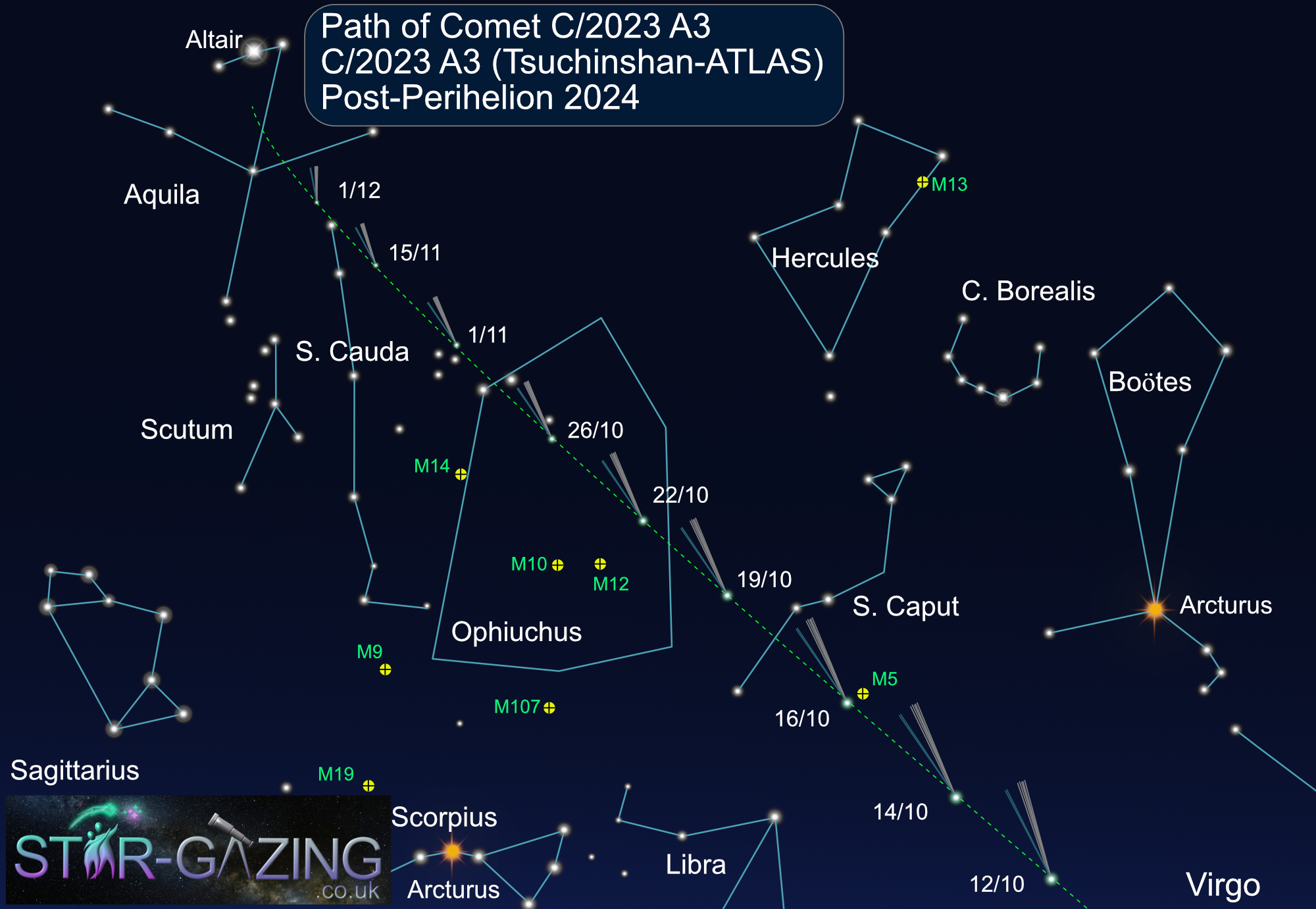
Objective:  To view and image Comet 2023 A3 Atlas-Tsuchinshan.  Here is a star chart, comet path map.

Report:  Oct16 in SJ

  • Very windy and cold.  Almost immediately found comet in binos.  It was higher in sky than I thought, but showed up bright with its huge long, needle-like tail that's approximately 5 degrees long(estimate from local observers Curt & Ed seems to be in agreement at 5 degrees).  Long exposure images shows tail to be much longer though. It's an awesome sight! Whitish color, with bright nucleus.  
  • Many images were ruined because of the wind, and a huge, strange looking cloud with a dark center in it passed in front of Moon as I was attempting to image it.
  • After taking images of comet for a few minutes, the tail started to show up naked eye with averted vision at approximately 1950hrs, looking like a contrail.  Shortly after this it was clearly visible naked eye, albeit faint.  Imo, brighter than Messier 31, the Andromeda Galaxy(magnitude 3.3) .  Brighter than M31 only because it could be seen naked eye from inside the city with a nearly full Moon,  Comet showed up like M31 does under dark skies. I would estimate comet brightness at magnitude 2.5.  
  • There was bright, almost full Moon rising in the East that shone like a huge spotlight.
With 18-55 lens.


With 75-300mm lens

Through clouds.

Oct 17 in SJ
  • I was not able to get the comet naked eye on this night, possibly because of the brighter full moon or because of hazy sky conditions.  Others, locally(4ppl in 2 different locations) are reporting that they seen it naked eye before 2000 hrs.
  • Comet was higher than reported by 5 degrees.  It was reported to be declination 1 degree, but I ended up finding it on my own at declination 6 degrees, which is a very rare mistake, in my experience. 
  • Comet was next to Unukalhai, Alpha Serpentis(mag 2.63). Unukalhai is Arabic for "Neck of the Serpent."   
  • The comet did pop out easily in binoculars.  Imo, the comets tail seemed much more faint than the night before.  Probably because of sky conditions from my location.  Comet went down below the horizon about 2125hrs.
  • Imaged Alkaid, a star in Ursa Major.  Magnitude 1.86. 
  • The full moon was super bright, high in the eastern sky.
Alkaid, Magnitude 1.86.  Image 30s, ISO 100 through telescope.

Comet located in Serpens, next to Unukalhai, Alpha Serpentis.  Image was taken with 18-55mm lens, 30s, ISO 100.  Single shot. 

Comet through telescope. 30s, ISO 100.

Full Hunter's Super Moon.


Oct 19 in POW
  • Got there early, before dark to try to get comet before the bright, 91% illuminated waning gibbous moon rose and washes out the barely naked eye comet.  Once it got completely dark, the comet was naked eye bright, approximately Mag 3, enough to be able to see directly to find in telescope and binos without having to star hop.
  • Comet was massive and very bright in binoculars, a truly wonderful sight.  Through the binos, I could easily see two stars through the comets tail, which was an amazing thing to see.  
  • Once the moon rose at around 2030 hrs, the comet was no longer naked eye bright  It was not even visible with averted vision and I could just barely find it in binoculars.  It was shocking how much the comet was washed out by the moon.  Most of its tail was no longer visible in the binoculars field of view and even the nucleus was a small fraction of what it was before the moon interfered.
  • Halfway through observing a local person stopped and spoke to me about how long people from SJAC have been using that site for observing, how much the trees have grown up, and that there was a bear around the area causing issues.  

Comet through telescope, before moon rise.  30s ISO 1600 

Comet just before moon rise 2027hrs.  25s ISO 1600

Waning Gibbous Moon 91% illuminated at 2034 hrs.


Oct 20 in Prince of Wales with Ed.
  • It got dark enough to see comet naked eye at approximately 1940hrs.  Spectacular comet that's tail is way too long to fit in binocular field of view.  Images had to be taken with a short focal length to get whole tail into frame.  Ed and I guessed at approximately 8 degree long tail with naked eye and agreed that tail is probably much longer than what we can see naked eye.

Image taken at 2006hrs Focal length 75mm, 10sec, ISO 6400.  Inverted. Sun directed anti-tail can clearly be seen in this image.

  • Halfway through observing Ed and I observed what we thought was an Orionid meteor, in the Eastern sky, bright, orangish/reddish fast, coming from approximately Orion's direction, which wasn't up yet.  The Orionids peak today, but the brightening moon will not help.  Note:  Someone on Facebook noticed "a bright fireball" at 8pm, at the same about the same time.
  • Ed mentioned that M31 Andromeda Galaxy was up in the north eastern sky and so we both viewed it with our binoculars for a brightness/size comparison with the comet.  We both think the comet is much brighter than M31, even though the moon may have affected M31 in my side by side comparison image.
M31/comet comparison image.  Camera settings the same for both.  Focal length 55mm, 32sec, ISO 1600.

  • Moon was just starting to rise in the East when we left at 2110hrs.
Oct 22 POW nature trail parking lot.
  • Benson, Ed and I were happy to see Curt at location.  Shortly after arriving we all confirmed seeing the comet naked eye.  Benson remarked that "it looked like a line in the sky".  Great description!  That's exactly what it looks like.  Through binoculars Benson thought he could see greenish color.  To me it looks more like a dirty whitish color.  This was Benson's first comet.
  • Ed and I thought the comet held about the same brightness as two nights before.  It's still a little brighter than M31.
  • I seen a shooting star about halfway through observing low in the northwest, to the west of Ursa Major.
  • Ed observed the Double Cluster.
focal length 55mm, 21sec, f/5.6, ISO 6400

focal length 80mm, f/4.0, 10sec, ISO 6400

Same as above.  Inverted.

M31 vs Comet for brightness.  Camera settings are the same.  focal length 80mm, 21sec, f/4.0, ISO 6400


Oct 25 from POW parking lot
  • Ed and I arrived just as it was starting to get dark.  Shortly after, we were able to find the comet in binoculars and we both agreed that the comet has dimmed some.  It's now about equal in brightness to M31 (mag 3.4), imo, although Ed thinks comet is a little dimmer than M31.
  • The comet is still naked eye bright, but we think that it's only visible because we were in remarkably dark skies.  Probably not visible from light polluted skies like a cities.
  • By 2000 hrs the skies were very dark.  I could see five stars in the square of Pegasus, which it is said to mean a limiting factor of mag 5.  Very good viewing conditions except for some haziness.  It was so dark, with only stars showing making it difficult to focus my short lenses.
  • Ed and I both noticed many satellites and a number of shooting stars.  All of the shooting stars were heading in the western direction.  The one that I seen was high in the southern sky, streaked over Delphinus heading towards the comet, at about 2036hrs.
  • Ed remarked about Cassiopeia which was nicely placed for viewing in the north eastern sky.
  • Comet has some kind of star cluster in the tail and is in images.  When I determine its identity I will update this post.  The cluster showed up nicely in binos as well.
Comet vs M31 brightness comparison images.  Camera settings were the same. Single shot, focal length 55mm, 21seconds, f/5.6, ISO 6400

Comet approaching IC 4665. Same settings as above.

Single shot, focal length 180mm, 4sec, f/5.0, ISO 6400.

Same settings as above, inverted.


Oct 29 at POW Nature Trail parking lot
  • Ed and I arrived around 1920 hours, but complete darkness not until about 1950 hours. For the first time, the comet was not visible to the naked eye, although M31 was still observable, indicating that the comet has significantly dimmed as it travels away from Earth into deeper space. The comet was clearly visible through binoculars, positioned near a bright star and adjacent to one of the numerous open clusters in Ophiuchus, appearing much smaller and fainter within the binoculars' field of view than on previous nights.  The comet dimmed so much that I had difficulty finding it in binoculars.
settings the same for both images. 155mm, 10sec, f/5.0, ISO 6400


150mm, 6.2sec, f/5.0, ISO 6400


Comet and IC 4665.  150mm, 4sec, f/5.0, ISO 6400


  • While scanning the skies for the comet with my binoculars, I chanced upon one of my favorite sights for binoculars or a small telescope: The Coat Hanger asterism, also known as Brocchi's Cluster. It's fascinating how a simple collection of stars can arrange themselves into a shape that's so easily recognizable.
150mm, 4sec, f/5.0, ISO 6400


Nov 2 from nature trail parking lot in POW

  • The comet may no longer be visible to the naked eye, yet it remains a splendid sight through binoculars, albeit smaller and fainter than before. It's situated in the star-rich Ophiuchus constellation and has drifted past the second brightest Ophiuchus star, Cebalrai(Arabic for Heart of the Shepard) and IC 4665 open cluster, which still appears in many of my wide-angle images. This star and cluster also serves as an excellent reference points for locating the comet with binoculars. Each night, the comet slowly recedes from Earth, shifting upward and slightly to the left. The extremely dark skies provide an ideal backdrop, although the windy and cold conditions pose challenges for imaging.
Cebalrai & IC4665 are bottom center. The famed, 9th magnitude Barnard's Star is very close to where the comet in this image. It's one of the closest stars to Earth. 75mm, 6.2sec, f/4.0, ISO 6400.


Comet size/brightness comparison from 20 Oct to 2 Nov.


Comet passing near IC 4665 (lower right) 75mm, 10sec, f/4.0, ISO 6400


Comet vs M31 for brightness/size comparison.  75mm, 10sec, f/4.0, ISO 6400

Zoomed in 250mm, 2.5sec, f/5.6, ISO 6400

  • I used bright star Alpha Aurigae, Capella(the Goat Star) to focus my camera on. The star, which is one of the brightest in the sky, was rising in the low north eastern sky.  This star is a beautiful shade of red/orange.
Capella about to be eclipsed by powerlines. 250mm, 4sec, f/5.6, ISO 6400

  • The Double Cluster in Perseus and M31 were clearly visible to the naked eye in the northeast during observation. I've been using M31, in particular, as a benchmark for brightness comparison with the dimming comet. These celestial objects are conveniently situated around the W asterism of Cassiopeia. The Double Cluster presents an astonishing view through binoculars due to its size, luminosity, and star density.
Double Cluster in Perseus, 75mm, 6.2sec, f/4.0, ISO 6400


Nov 10
  • The comet, reported to have a magnitude of 7.6, was expected to be located in the sky roughly halfway between IC 4665 and Altair. Upon arrival, Ed and I immediately surveyed this region with our binoculars. Ed believed he spotted a comet, but I did not see it. Soon after, a thin layer of clouds obscured the area where the comet was anticipated to be. I attempted to photograph the region, but the bright gibbous moon cast distinct shadows on the ground, and the clouds interfered, preventing confirmation of the comet through binoculars or in the images.


Area of sky where comet is reported, through a thin layer of clouds. 75mm, 8sec, f/4.0, IS0 400


Followers

Blog Archive